Four groups of Greek letters. One enduring proclamation of faith. Discover the meaning, history, and spiritual significance of one of Orthodox Christianity’s most recognizable inscriptions.
If you’ve spent any time inside an Orthodox Christian church, you’ve probably encountered the letters IC XC NIKA. You may have noticed them surrounding an ornate cross, painted on an icon, embroidered on a priest’s vestments, or stamped into the bread prepared for the Divine Liturgy. Perhaps you’ve seen them on a necklace, a wooden prayer corner cross, or even a T-shirt. To someone unfamiliar with Orthodox Christianity, those letters can seem mysterious. They don’t look like ordinary English initials, and their arrangement doesn’t immediately suggest a familiar phrase.
Yet their meaning is surprisingly simple. IC XC NIKA means “Jesus Christ Conquers,” or “Jesus Christ Is Victorious.” Behind those few letters is one of the central proclamations of Christianity: through His death and Resurrection, Jesus Christ has overcome sin and death. It’s a message of hope, salvation, and victory that has endured for centuries, passed down through generations of Christians and preserved in the sacred traditions of the Orthodox Church.
But there’s more to this inscription than its English translation. To fully appreciate its significance, we need to explore the Greek language, the symbolism of the Orthodox cross, the traditions of Byzantine Christianity, and the place this declaration holds in Orthodox worship. Along the way, we’ll discover why these ancient letters continue to carry such a meaningful message today.
What Does IC XC NIKA Mean in Greek?

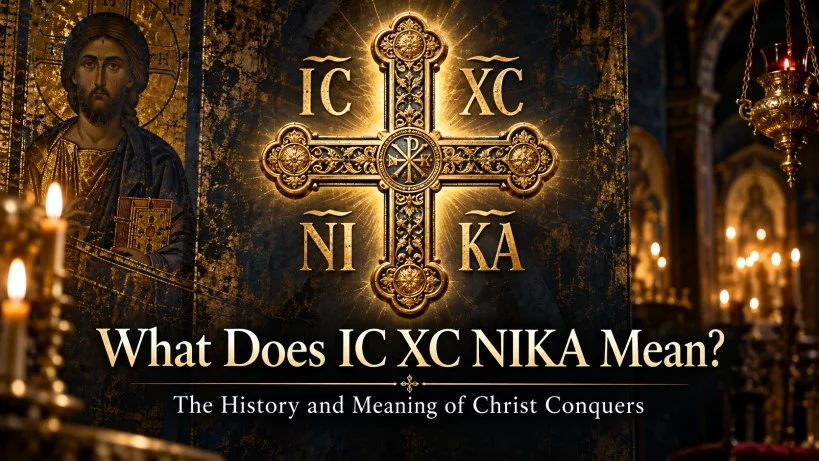
The traditional Greek expression behind the inscription is Ἰησοῦς Χριστὸς νικᾷ, meaning Jesus Christ Conquers. The familiar arrangement uses IC as an abbreviation of Ἰησοῦς (Iēsous), meaning Jesus, and XC as an abbreviation of Χριστός (Christos), meaning Christ. NIKA represents the Greek word νικᾷ, which means “conquers” or “is victorious.”
When the inscription appears around an Orthodox cross, you’ll often see the letters arranged as IC and XC on the upper sections, with NI and KA below. The word NIKA is simply divided to fit the cross’s design, and the meaning remains unchanged. One interesting distinction is that IC and XC are abbreviations, while NIKA is a complete Greek word. Understanding that detail makes the inscription much easier to recognize when you encounter it in different forms of Orthodox Christian artwork.
Why Is There a C Instead of an S?
One question people frequently ask concerns the unusual spelling. If Jesus is Iēsous and Christ is Christos, shouldn’t the abbreviations contain an S instead of a C?
The answer lies in the Greek alphabet. The character that looks like the English letter C is actually a traditional form of the Greek letter sigma, known as the lunate sigma. It represents the same S sound. The abbreviations IC and XC use the first and last letters of the Greek names for Jesus and Christ, preserving a convention that has been part of Christian writing and iconography for centuries.
You may also notice a small horizontal line above these letters in traditional icons. This mark indicates an abbreviated sacred name, a practice found in early Christian manuscripts as well as later religious artwork. Once you understand these conventions, the letters become less mysterious, and you’ll start recognizing them almost immediately.
What Does “Christ Conquers” Really Mean?
When we hear the word conquers, our minds naturally turn toward military victories, athletic competition, or one person overcoming another. We live in a world where victory is often measured by wealth, influence, physical strength, or public recognition. That makes the Christian meaning of IC XC NIKA particularly important, because the victory proclaimed by the Orthodox Church is something entirely different.
Christ conquers sin and death through His voluntary sacrifice on the Cross and His glorious Resurrection. This is at the very heart of Christianity. To those who witnessed the Crucifixion, it may have appeared that Christ had suffered a terrible defeat. He had been betrayed, condemned, mocked, and executed. Yet Christianity teaches that what looked like defeat became the means of humanity’s salvation. Through His death, Christ entered into the depths of the human condition, and through His Resurrection, He defeated death and opened the way to eternal life.
This is why Orthodox Christians celebrate Pascha, the Feast of the Resurrection, with such extraordinary joy. The Church’s Paschal hymn proclaims that Christ has trampled down death by death. It is also why the Cross, once an instrument of suffering and execution, has become a symbol of victory, hope, and salvation. The inscription IC XC NIKA expresses that understanding in just a few letters.
Of course, Christ’s victory doesn’t mean that Christians will never experience hardship. It doesn’t promise financial success, perfect health, physical strength, or an easy life. The Gospel offers no such guarantees. In John 16:33, Christ tells His disciples that they will face tribulation in the world, while encouraging them to take heart because He has overcome the world. For Orthodox Christians, that promise provides hope even in the midst of suffering. We may struggle with illness, loss, uncertainty, or temptation, but these difficulties do not erase the victory of the risen Christ.
This is an important distinction, particularly in a culture that often equates success with personal achievement. IC XC NIKA is not a celebration of human power. It is a declaration of Christ’s triumph over sin and death.
IC XC NIKA and the Orthodox Cross
The Orthodox cross is one of the most recognizable symbols of Eastern Christianity. Many people immediately think of the traditional three-bar cross, but Orthodox Christians also use Greek crosses, simple crosses, and elaborately decorated Byzantine-style crosses. The IC XC NIKA inscription appears with several of these designs, often arranged around the four sections of the cross.
In a common arrangement, IC appears in the upper-left section, XC in the upper-right, NI in the lower-left, and KA in the lower-right. This creates a balanced design while connecting the written proclamation of Christ’s victory directly to the Cross itself. The visual arrangement is simple, but its meaning is profound. The Cross reminds us of Christ’s sacrifice, while the inscription proclaims His victory.
At first, it might seem strange that a symbol associated with suffering and execution should also represent triumph. Yet that’s precisely what makes the Christian cross so significant. The Crucifixion cannot be separated from the Resurrection. Orthodox Christians do not venerate the Cross simply as a reminder of a tragedy that occurred two thousand years ago. They honor it because of the saving work accomplished through Jesus Christ.
This connection between the Cross and the Resurrection helps explain why IC XC NIKA is so frequently incorporated into Orthodox Christian crosses. The letters don’t merely decorate the artwork. They proclaim what the Cross means within the Christian faith.
The History of IC XC NIKA in Orthodox Christianity
The use of abbreviated sacred names has deep roots in Christian history. Early Christian scribes developed conventions for shortening important names and titles, particularly those referring to God and Jesus Christ. Scholars often refer to these abbreviations as nomina sacra, meaning sacred names. As Christianity developed its artistic traditions, these shortened forms began appearing not only in manuscripts but also in icons, inscriptions, and other religious objects.
The letters IC XC became a familiar way of identifying Jesus Christ in Byzantine Christian art. The longer inscription IC XC NIKA, proclaiming His victory, likewise became an established feature of Orthodox crosses and liturgical objects. Its use continued through the centuries as Orthodox Christianity spread beyond the Greek-speaking world into Slavic lands and other regions.
The Byzantine Empire played an especially important role in shaping the artistic and liturgical traditions of Eastern Orthodox Christianity. Byzantine religious artwork developed a distinctive visual language that included gold backgrounds, symbolic colors, intricate crosses, carefully arranged inscriptions, and stylized religious figures. These elements were not chosen merely for decoration. They helped communicate the Christian faith through images that could be recognized and understood by generations of believers.
Today, an Orthodox Christian attending a parish in Greece, Serbia, Romania, Russia, or the United States may encounter the same inscription. The language of worship, musical traditions, and local artistic styles may differ, but the underlying proclamation remains familiar: Jesus Christ conquers.
Is IC XC NIKA Connected to Emperor Constantine?
You may occasionally encounter explanations connecting IC XC NIKA with St. Constantine the Great. There is a historical and traditional connection through Christian victory symbolism, but it’s important not to confuse two different expressions.
According to Christian accounts of Constantine’s experience before the Battle of the Milvian Bridge, he encountered a heavenly sign associated with a declaration often translated as “In this sign, conquer.” The Greek expression commonly associated with that tradition is En Touto Nika. While this shares the language of victory, it is not identical to IC XC NIKA.
The distinction matters because IC XC NIKA specifically proclaims that Jesus Christ conquers. Its primary significance is theological rather than military or political. The victory it announces is Christ’s triumph over sin and death, not the success of an earthly ruler or army.
Where Is IC XC NIKA Used in Orthodox Worship?
One of the most interesting things about this inscription is how frequently it appears in Orthodox Christian life. It’s found in places that many visitors might overlook, and some of its uses have a particularly deep connection to the Church’s worship.
Orthodox Icons and Sacred Artwork
Icons hold an important place in Orthodox Christianity, depicting Christ, the Theotokos, angels, saints, and events from salvation history. In many icons of Jesus Christ, the letters IC and XC appear on either side of His image, identifying Him by name. These inscriptions are particularly familiar in icons of Christ Pantocrator, where Christ is portrayed as the ruler of all.
The full IC XC NIKA inscription also appears alongside crosses and other traditional religious compositions. In Orthodox iconography, written inscriptions are part of the meaning of the image. They help identify the holy persons and subjects depicted while preserving familiar theological expressions.
IC XC NIKA on Prosphora Bread
Perhaps one of the most meaningful uses of the inscription appears on the bread prepared for the Divine Liturgy.
In Orthodox Christianity, this offering bread is called prosphora, a Greek word associated with offering. Traditionally, the bread is marked with a special seal featuring a cross and the inscription IC XC NI KA. During the preparation of the Holy Gifts, known as the Proskomedia or Liturgy of Preparation, the priest cuts a central portion from the bread called the Lamb. This portion bears the IC XC NIKA seal and is prepared for consecration during the Divine Liturgy.
The Lamb represents Jesus Christ, the Lamb of God. Other portions of the bread are prepared in commemoration of the Theotokos, the saints, and members of the Church. The symbolism is deeply connected to Orthodox Eucharistic worship and the saving sacrifice of Christ.
Consider the significance of that for a moment. The same inscription that appears on an ornate cross or traditional icon is also impressed upon the bread prepared for the Eucharist. It isn’t merely an artistic expression preserved from Byzantine history. It remains part of the living worship of the Orthodox Church.
The Traditional Orthodox Blessing
Another fascinating connection can be found in the way Orthodox clergy bless the faithful. If you’ve watched an Orthodox priest or bishop give a blessing, you may have noticed the distinctive arrangement of the fingers.
That gesture isn’t random. In the traditional Orthodox blessing, the fingers are positioned to represent the Greek letters IC XC. The arrangement symbolizes the name of Jesus Christ, in whose name the blessing is given. A similar hand position can be seen in many Orthodox icons of Christ Himself.
Once again, we see how traditional Christian symbols connect written language, sacred imagery, and the actions of worship. The name of Christ is expressed not only through words but also through the physical gestures preserved within Orthodox tradition.
Crosses, Vestments, and Other Religious Objects
Beyond icons and liturgical bread, IC XC NIKA can be found on wooden crosses, metal crosses, vestments, devotional artwork, and church decorations. Some representations are simple, with the letters arranged around a plain cross. Others feature elaborate Byzantine patterns, intricate borders, and carefully detailed ornamentation.
Different Orthodox cultures have developed their own artistic expressions, yet the inscription remains remarkably consistent. Whether displayed in a centuries-old church or engraved on a modern devotional object, its message is unchanged.
IC XC NIKA vs. INRI: What’s the Difference?
People sometimes confuse IC XC NIKA with another inscription commonly associated with Christian crosses: INRI. Although both refer to Jesus Christ, they have different origins and meanings.
INRI comes from the Latin phrase Iesus Nazarenus Rex Iudaeorum, meaning “Jesus of Nazareth, King of the Jews.” It refers to the title placed above Christ during His Crucifixion, as described in the Gospels. IC XC NIKA, by contrast, is a Greek declaration proclaiming that Jesus Christ conquers.
INRI identifies Jesus through the title associated with His Crucifixion, while IC XC NIKA emphasizes His victory. Both inscriptions belong to Christian tradition, but they shouldn’t be treated as interchangeable. Understanding the difference can help when examining various forms of Christian crosses and religious artwork.
Why IC XC NIKA Still Matters Today
It’s easy to admire the beauty of Byzantine Christian art. The gold, the intricate patterns, the symmetry, and the traditional Greek lettering all contribute to its distinctive appearance. But Orthodox Christianity doesn’t preserve these symbols simply because they’re attractive. Their purpose is to direct our attention toward Christ and the truths of the Christian faith.
That purpose remains every bit as relevant today as it was centuries ago.
Modern society places enormous emphasis on achievement. We’re encouraged to become more successful, earn more money, improve our appearance, accumulate possessions, and continually compare ourselves with others. Even worthwhile pursuits, such as physical fitness, can become exercises in vanity when personal appearance or recognition becomes more important than health, discipline, or character.
The Christian understanding of victory challenges those assumptions. IC XC NIKA reminds us that the ultimate victory belongs to Christ rather than to our personal accomplishments. It encourages a different perspective on strength, success, and the way we approach everyday life.
Faith, Fitness, and Genuine Strength
At Orthodox Bros, faith, fitness, and brotherhood are central to our philosophy. We believe that caring for our physical health, developing self-discipline, and supporting one another can complement a life centered on prayer, humility, repentance, and spiritual growth. Physical training can teach patience and perseverance, and consistent effort can help develop habits that carry over into other areas of life.
However, physical strength is not the same as spiritual maturity. Someone can be exceptionally strong, athletic, or accomplished while still struggling with anger, selfishness, impatience, or a lack of compassion. Likewise, an elderly person, someone living with illness, or an individual with physical limitations may demonstrate extraordinary courage, humility, and faith.
There’s nothing wrong with wanting to become healthier or stronger. The important question is what motivates that desire and how we use the abilities we’ve been given. Are we seeking attention and admiration, or are we developing ourselves so we can live more responsibly, serve others, and better fulfill our obligations?
IC XC NIKA provides a useful reminder that our worth is not measured by physical accomplishments or worldly recognition. The Christian life calls us toward humility and love, not self-glorification.
Brotherhood Means More Than Shared Interests
The same principle applies to brotherhood. Genuine Christian brotherhood isn’t built around competition or the desire to appear superior to others. It’s built through loyalty, encouragement, forgiveness, and a shared commitment to living faithfully.
Sometimes brotherhood means helping a friend through a difficult period. Other times it means offering practical assistance, encouraging someone who has become discouraged, or simply being willing to listen. These actions may not attract attention, but they’re far more meaningful than outward displays of strength.
The Orthodox Christian life isn’t a competition to determine who is the strongest, most disciplined, or most knowledgeable. It’s a life of prayer, repentance, worship, service, and love for others. The message of IC XC NIKA reminds us that the foundation of that life is Christ’s victory, not our own achievements.
Is It Appropriate to Wear IC XC NIKA on Clothing?
With traditional Orthodox Christian symbols appearing on shirts, hoodies, hats, and other everyday items, it’s reasonable to ask whether wearing them is appropriate.
Orthodox Christians may have different opinions about how sacred imagery should be used outside a church setting. Some appreciate clothing featuring traditional crosses and inscriptions because it serves as a reminder of their faith and sometimes encourages meaningful conversations. Others prefer a more reserved approach, particularly when clothing includes detailed depictions of Christ, the Theotokos, or saints.
Those concerns deserve respect. A cross or sacred inscription isn’t simply another decorative logo, and Orthodox Christianity has always placed importance on treating holy things with reverence.
At Orthodox Bros, our approach is to create designs inspired by the beauty and traditions of Orthodox Christianity while taking their meaning seriously. An IC XC NIKA design isn’t a magical object, a substitute for prayer, or proof that someone is more faithful than another person. Its value lies in the truth it proclaims and the reminder it can offer.
As with other questions involving personal devotional practices, Orthodox Christians can seek guidance from their parish priest when uncertain.
A Reminder for Everyday Life
Imagine starting your morning with a long list of responsibilities. Work needs attention, the house needs repairs, family members need help, and there are appointments to keep. Before long, a dozen unexpected interruptions have made a mess of your plans. Some days, even finding a few peaceful minutes for prayer can feel difficult.
It’s often in the middle of ordinary life that small reminders become meaningful. Seeing a cross, encountering a familiar prayer, or recognizing the letters IC XC NIKA may prompt us to remember where our hope belongs. Such reminders don’t eliminate our problems, but they can help us approach them with a different perspective.
Not every day will bring an obvious victory. Not every problem will have an immediate solution, and not every struggle will disappear simply because we pray. The Christian faith isn’t built on a promise that life will always be comfortable or free of suffering. It rests on the victory of Jesus Christ.
IC XC NIKA reminds us that the Resurrection, not death, has the final word.
Frequently Asked Questions About IC XC NIKA
What is the English translation of IC XC NIKA?
IC XC NIKA means “Jesus Christ Conquers” or “Jesus Christ Is Victorious.” It is a traditional Greek Christian proclamation of Christ’s victory over sin and death.
What language is IC XC NIKA?
The inscription comes from Greek, the language in which the New Testament was originally written and one that has played a central role in Orthodox Christian history, theology, and worship.
Why is IC XC NIKA written around an Orthodox cross?
The arrangement connects the proclamation of Christ’s victory with the Cross and Resurrection. The letters IC XC commonly appear above the arms of the cross, while NI KA appears below.
Does NIKA mean victory?
NIKA is a form of the Greek verb meaning “conquers” or “is victorious.” It is related to the broader Greek vocabulary of victory.
Is IC XC NIKA exclusively an Orthodox Christian symbol?
The inscription is particularly associated with Eastern Orthodox and Byzantine Christian traditions. It also appears in related Eastern Christian traditions that share elements of Byzantine liturgical and artistic heritage.
What does IC XC mean on an icon of Jesus?
IC XC is the traditional Greek abbreviation for Jesus Christ. It commonly appears beside His image in Orthodox Christian iconography.
What does IC XC NIKA mean on Communion bread?
The inscription is stamped onto the bread prepared for the Divine Liturgy. The central portion bearing the seal is called the Lamb and is prepared for consecration during the Eucharist.
Explore the Orthodox Bros IC XC NIKA Collection
The enduring message of IC XC NIKA inspired one of our designs in the Orthodox Bros Ancient Faith Collection. Featuring an ornate Byzantine-style Orthodox cross and the traditional Christ Conquers inscription, our premium heavyweight cotton T-shirts combine classic Christian symbolism with comfortable everyday clothing.
The collection includes four distinctive colors: Black, which creates a striking contrast with the ornate gold artwork; Crimson, a rich red that complements the Byzantine-inspired design; Pepper, with its vintage washed-charcoal appearance; and Midnight, a deep navy blue that offers an alternative to traditional black.
Each shirt features the same proclamation that has been preserved in Orthodox Christian tradition for centuries: IC XC NIKA — Jesus Christ Conquers.
Explore our IC XC NIKA collection and discover our premium Orthodox Christian T-shirts.
Final Thoughts: Ancient Words, Enduring Truth
It’s remarkable how much meaning can be carried by such a small inscription. IC XC NIKA isn’t a complicated theological formula reserved for scholars, clergy, or historians. It’s a straightforward proclamation of the central hope of Christianity: Jesus Christ conquers.
The same words that have appeared for centuries on crosses, icons, and liturgical bread continue to remind Orthodox Christians of the victory of the risen Lord. Understanding these letters can deepen our appreciation for the beauty and meaning of Orthodox Christian traditions. More importantly, understanding what they proclaim can encourage us to approach everyday life with greater faith, humility, gratitude, and hope.
The world changes. Fashions come and go. Kingdoms rise and fall. Our own circumstances can change dramatically from one year to the next. Yet the central proclamation of the Christian faith remains unchanged.
Christ’s victory remains. IC XC NIKA — Jesus Christ Conquers.
Ancient Faith. Modern Brotherhood.
Further Reading and Orthodox Sources
For readers who would like to explore the theological and liturgical background of this inscription:
- Greek Orthodox Archdiocese of America — Prosphora: The bread offered for Divine Liturgy and the significance of its seal.
- Orthodox Church in America — Placement of Fingers in Icons: An explanation of how IC XC is represented in the traditional blessing gesture.
- Greek Orthodox Archdiocese of America — History of the Archdiocese Logo: The meaning of its cross, inscriptions, and associations with Byzantine symbolism.
- Greek Orthodox Archdiocese of America — Great and Holy Saturday: The theological significance of Christ’s death and victory over death.