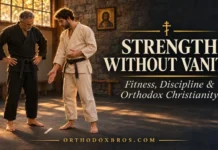

There is no shortage of advice these days about what it means to be a man. We’re told to become stronger, tougher, more successful, more confident, and more independent. There are endless books, podcasts, videos, and self-appointed experts offering formulas for building the ideal masculine life. Some of that advice is useful, particularly when it encourages responsibility, physical health, and self-control. But a great deal of it seems to revolve around the same question: How can I become more impressive?
Orthodox Christianity asks us to consider something considerably more important.
How can I become more faithful to Christ? How can I become a better husband, father, son, brother, friend, or neighbor? How can I learn to control my passions rather than allowing them to control me? And perhaps most importantly, how can I develop the humility to recognize that I am still very much a work in progress?
These questions don’t lend themselves to flashy social media demonstrations. Nobody becomes a better Christian simply by growing a beard, lifting heavy weights, wearing an Orthodox cross, or memorizing impressive quotations from the Church Fathers. There is nothing inherently wrong with any of those things, but outward appearance is a poor substitute for genuine spiritual growth.
The Orthodox Christian life requires something deeper. Prayer, repentance, worship, self-restraint, sacrifice, humility, and love are not particularly fashionable concepts in a culture that often celebrates individual achievement above everything else. Yet these are among the very things that give a man’s life direction and meaning.
At Orthodox Bros, we believe physical strength, healthy living, and personal discipline can have a worthwhile place in this journey. A strong and capable body can help a man fulfill his responsibilities, care for his family, serve his community, and remain active as he grows older. But physical fitness is not holiness, and masculinity is not an excuse for arrogance, aggression, or treating others as inferior.
What follows are twelve disciplines worth cultivating in the life of an Orthodox Christian man. They are not an official list of Church commandments or a replacement for the guidance of a parish priest or spiritual father. Rather, they are a practical way of exploring how the timeless teachings of Orthodox Christianity can shape our decisions, habits, relationships, and everyday responsibilities.
Some will come more naturally than others. All require attention, and none of us will practice them perfectly.
That’s part of the reason we need them.
1. Prayer: Learn to Put God Before the Noise
The first discipline is also the foundation for everything that follows. Prayer is not something an Orthodox Christian man fits into his schedule only after the important business of the day is finished. It is part of what gives that business its proper meaning. Without prayer, even the most carefully organized life can become a collection of obligations, ambitions, and distractions with very little consideration of where we’re actually headed.
Many of us reach for our phones before we’ve even gotten out of bed. Within minutes, we’re reading messages, checking the news, or responding to problems that might not require our immediate attention. By the time we think about prayer, our minds are already racing. Establishing a regular morning and evening prayer rule, appropriate to our circumstances and preferably developed with pastoral guidance, is one way to begin changing that pattern.
The Orthodox Church gives us a rich tradition of prayer, including the Psalms, morning and evening prayers, and the Jesus Prayer: Lord Jesus Christ, Son of God, have mercy on me, a sinner. These aren’t words we repeat to demonstrate spiritual accomplishment. They help us turn our attention toward God, acknowledge our dependence upon His mercy, and gradually develop a more prayerful way of living.
A man doesn’t need to begin with an elaborate routine. Five attentive minutes can be a more sensible starting point than an ambitious hour he abandons after three days. The discipline is to make prayer part of ordinary life rather than waiting until we feel particularly inspired or encounter a crisis.
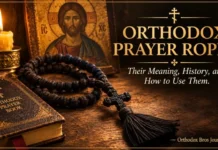
If you’d like to learn more about the Jesus Prayer and its history, we’ve explored that tradition in our article on Orthodox Prayer Ropes: Their Meaning, History, and How to Use Them.
2. Worship: Remain Rooted in the Life of the Church
Orthodox Christianity is not something we practice entirely on our own. We don’t become Orthodox simply by reading theology, collecting icons, discussing doctrine online, or watching videos about ancient traditions. The Church is a living community gathered around the worship of God, and participation in that community is essential to Orthodox Christian life.
The Divine Liturgy stands at the center of that life. Through the Church’s worship, sacraments, feasts, fasts, and seasons of repentance, Christians are continually called away from self-absorption and toward communion with God and one another. A man who takes his faith seriously should therefore make a genuine effort to attend the services of his parish, participate in the sacramental life of the Church, and seek appropriate guidance from his priest.
This sounds straightforward until ordinary responsibilities begin competing for our time. Work schedules, family commitments, fatigue, and the demands of modern living can make regular church attendance difficult. Some men face circumstances that genuinely limit their participation, including illness, disability, or caring for someone who depends upon them. The answer isn’t to condemn people whose situations differ from our own, but to approach our responsibilities faithfully and make worship a priority wherever possible.
There is also a lesson in simply being present among other people. Parish life brings together individuals of different ages, backgrounds, abilities, and personalities. We may not particularly enjoy everyone’s company, and we certainly won’t agree about everything. Learning to worship alongside people who occasionally irritate us is itself an opportunity to practice patience, forgiveness, and humility.
A man who wants to grow in his faith needs more than an internet connection and a collection of religious opinions. He needs the Church.
3. Repentance: Take Responsibility for Your Failures
One of the more unfortunate ideas associated with modern masculinity is that admitting a mistake somehow makes a man appear weak. We’re encouraged to defend our position, protect our reputation, and avoid showing vulnerability. The result is that otherwise capable men can spend enormous amounts of energy justifying behavior they know was wrong.
Orthodox Christianity offers a very different understanding of strength. Repentance requires us to acknowledge our sins honestly, seek God’s mercy, and make a genuine effort to change. It is not simply feeling guilty or promising ourselves that we’ll behave better next time. The Greek word metanoia, associated with repentance, expresses a change of mind and direction—a turning away from sin and toward God.
This is especially important in our relationships. A man who loses his temper with his wife, speaks harshly to his children, treats a coworker unfairly, or betrays a friend’s confidence should be willing to acknowledge what happened. An apology offered without excuses can require more courage than a lengthy argument intended to prove that we were justified. When appropriate, repentance also means making amends and accepting that rebuilding trust may take time.
The Orthodox sacrament of Confession provides an important setting for acknowledging sin and seeking reconciliation with God. It reminds us that repentance is not merely a private self-improvement project. We need mercy, healing, and guidance, and we are not always capable of recognizing the full extent of our own weaknesses.
A man committed to repentance doesn’t pretend he never falls. He learns to recognize when he has fallen, accepts responsibility, and returns to Christ.
4. Humility: Become Strong Without Becoming Arrogant

Humility may be one of the most misunderstood virtues in modern life. Some associate it with passivity, weakness, or a lack of confidence. Others imagine that a humble person must constantly criticize himself or refuse to acknowledge any ability he possesses. Orthodox Christianity teaches something far more substantial.
Humility begins with seeing ourselves truthfully. We recognize our abilities without exaggerating them, acknowledge our limitations without despairing, and understand that whatever good we accomplish is ultimately dependent upon God’s grace. A man can be physically strong, professionally successful, highly educated, or exceptionally skilled without believing those qualities make him superior to anyone else.
Consider two men in a gym. One is experienced, capable, and eager to demonstrate how much he knows. He ridicules beginners, constantly compares himself with others, and treats every workout as an opportunity to establish his position. The other may possess just as much knowledge and physical ability, but he uses those gifts differently. He encourages newcomers, shares useful advice when asked, and has no difficulty admitting that he still has things to learn.
Which man demonstrates greater maturity?
The same principle applies to our spiritual lives. Knowing Orthodox theology, following a strict fasting rule, or attending many church services should never become a reason to look down on another Christian. Spiritual knowledge without love can become another opportunity for vanity. Humility reminds us that we are called to work on our own shortcomings before becoming overly concerned with those of everyone else.
True humility doesn’t prevent a man from acting decisively or defending someone who needs help. It simply prevents him from confusing responsibility with self-importance.
5. Fasting: Practice Self-Restraint Without Making a Performance of It
Fasting holds an important place in Orthodox Christian life, but its meaning is frequently misunderstood, especially when discussed alongside fitness and nutrition. In modern health culture, fasting is often presented primarily as a strategy for losing weight, controlling calories, or improving physical performance. Orthodox fasting serves a different purpose.
The Church’s fasting tradition is connected to prayer, repentance, generosity, and freedom from the passions. By voluntarily abstaining from certain foods at appointed times, Christians learn to confront the attachments and habits that can begin ruling their lives. The goal is not to prove how much discomfort we can tolerate. It is to become less dependent upon our appetites and more attentive to God.
Of course, food is only one area in which self-restraint matters. A man may faithfully observe dietary restrictions while remaining unable to control his anger, his appetite for alcohol, his spending, his sexual behavior, or the amount of time he wastes online. It would be a mistake to congratulate ourselves for following a fasting calendar while ignoring the destructive habits that affect our families and relationships.
Fasting should also be approached with wisdom. Men with medical conditions, medications, demanding physical work, or particular nutritional needs may require adjustments. These questions should be discussed with a priest and, when appropriate, a qualified healthcare professional. The spiritual purpose of fasting is not served by recklessly damaging one’s health.
The deeper lesson is that freedom requires more than the ability to do whatever we want. Sometimes genuine freedom is demonstrated by our willingness to say no.
6. Physical Fitness: Build a Body Capable of Serving Others
This is where the Orthodox Bros philosophy brings an additional emphasis to the discussion. Physical training is not a sacrament, and having an impressive physique does not make anyone a better Christian. Nevertheless, we believe there is considerable value in caring for the body, maintaining physical capability, and cultivating habits that support long-term health.
Saint Paul acknowledges the value of bodily training in 1 Timothy 4:8 while making clear that godliness has far greater significance. That distinction gives us a useful perspective. Physical fitness matters, but it should remain in its proper place. The purpose is not to make the body an object of worship or to become so preoccupied with appearance that other responsibilities are neglected.
For a younger man, physical discipline might involve strength training, martial arts, swimming, running, or another demanding activity. For a middle-aged man, the emphasis may gradually shift toward maintaining strength, managing stress, improving mobility, and avoiding injuries. An older man may discover that walking regularly, performing appropriate resistance exercises, and preserving balance are far more important than lifting the weights he once handled decades earlier.
There is dignity in adapting to reality. Age, injuries, illness, disability, and other limitations affect what each person can reasonably do. A man doesn’t become less worthy because he can no longer train like he did at twenty-five. The objective is to make responsible use of the abilities he has, improve them where possible, and remain capable of participating in life.
And there is a practical reason to value that capability. Being able to help someone carry a heavy object, work around the house, enjoy time outdoors with family, or remain independent as we grow older can make a genuine difference. Physical strength becomes particularly meaningful when it is used for something beyond personal appearance.
At Orthodox Bros, we encourage men to train with purpose, exercise good judgment, respect their limitations, and remember that the people around them matter more than their personal records.
7. Rest: Recognize That Discipline Includes Recovery
Some men take considerable satisfaction in being constantly busy. They work long hours, push through exhaustion, ignore pain, and regard rest as something to be earned only after every possible task has been completed. This attitude sometimes appears in fitness culture as well, where pushing harder is treated as the answer to nearly every problem.
But there is a difference between dedication and carelessness.
Our bodies require sleep, nourishment, and recovery. Muscles need time to adapt to training, and injuries often become worse when warning signs are ignored. There is nothing disciplined about repeatedly exhausting ourselves to the point that we become irritable, ineffective, or unable to fulfill our responsibilities. A sensible training program includes rest because recovery is part of the process, not a failure to work hard enough.
Rest also has a spiritual dimension. The Orthodox rhythm of worship, feasts, fasts, and ordinary work reminds us that life is not meant to become one uninterrupted pursuit of productivity. Time with family, peaceful conversation, shared meals, and the quiet enjoyment of God’s creation all have their place. We should not need an excuse to spend an afternoon with someone we love.
This becomes increasingly important as we get older. Men sometimes struggle to accept that their bodies have changed, particularly if they were once athletes, martial artists, soldiers, or engaged in physically demanding occupations. There can be a temptation to push beyond reasonable limits simply to prove that nothing has changed.
Wisdom means knowing when to work, when to train, and when to recover. A man who understands his limitations is often better equipped to remain active and useful over the long term.
8. Self-Control: Learn to Govern Your Words and Temper
A man who can lift hundreds of pounds but cannot control his temper has an important weakness to address. The same can be said of someone who is successful in business but routinely humiliates employees, or someone who speaks eloquently about Christianity while treating his own family with impatience and contempt.
Self-control is among the virtues identified by Saint Paul as a fruit of the Spirit. It involves much more than physical restraint. Our speech, desires, spending, entertainment, and responses to frustration all reveal the extent to which we’ve developed the ability to govern our behavior.
This discipline is particularly relevant in the age of social media. It’s remarkably easy to become involved in arguments that accomplish nothing. A provocative comment appears, someone insults our beliefs, and suddenly we’re spending an evening trying to defeat a stranger in a dispute that neither participant is interested in resolving. Even religious discussions can descend into personal attacks, mockery, and endless demonstrations of who possesses the correct information.
An Orthodox Christian man should be capable of defending his convictions without abandoning charity. There are occasions when we need to speak firmly, challenge wrongdoing, or protect someone from harm. But firmness does not require cruelty, and having a strong opinion does not give us permission to treat others without dignity.
One useful habit is learning to delay our response when emotions are running high. We do not need to answer every criticism immediately, win every disagreement, or offer our opinion on every controversy. Sometimes the most disciplined thing a man can do is remain silent long enough to consider whether his words will accomplish anything worthwhile.
Control over one’s temper is not an indication that a man lacks strength. It is one of the ways he learns to use strength responsibly.
9. Responsibility: Be Someone Others Can Depend Upon
There is an unglamorous side to manhood that rarely receives much attention. It involves getting up when we’d rather stay in bed, keeping promises when circumstances become inconvenient, paying our obligations, taking care of the house, and showing up for people who depend upon us.
These responsibilities don’t necessarily make for exciting stories, but they reveal a great deal about a person’s character.
For a married man, faithfulness includes treating his wife with love, respect, patience, and genuine consideration. It means recognizing that marriage is not a competition for authority but a shared life requiring sacrifice and responsibility. A father should be someone his children can trust, not merely a person they fear disappointing. He should demonstrate the conduct he hopes to see in them, understanding that children often learn more from what their parents do than from what they say.
Single men have responsibilities of their own, whether toward parents, relatives, friends, parish communities, or others entrusted to their care. Not every man’s life will follow the same pattern, and maturity should not be measured solely by marital status, income, or professional achievement.
Responsibility also includes honesty at work and fairness in business. A Christian man shouldn’t require constant supervision to do what he has agreed to do, nor should he excuse dishonesty simply because it might produce a financial advantage. Keeping commitments, communicating truthfully, and accepting the consequences of our decisions are all practical expressions of personal integrity.
There will be situations in which a man genuinely cannot meet every expectation placed upon him. Illness, unemployment, financial hardship, and family emergencies can change what is possible. In those circumstances, responsibility may involve asking for help, admitting that a situation is beyond our abilities, or making difficult choices about competing obligations.
Being dependable doesn’t mean pretending we can do everything alone. It means approaching our duties with sincerity and doing what we reasonably can.
10. Service: Use Your Abilities for Something Beyond Yourself
The Gospel repeatedly directs our attention toward the needs of others. Christ’s teaching about caring for the hungry, the sick, the stranger, and those in distress leaves little room for a purely self-centered understanding of Christian life. Prayer and fasting belong alongside generosity, compassion, and practical acts of love.
That doesn’t mean every act of service needs to be dramatic. Sometimes it’s helping an elderly neighbor with something around the house, driving someone to an appointment, preparing a meal for a family dealing with illness, or taking the time to listen when a friend is going through a difficult period. These acts may never attract recognition, but they can make a tremendous difference to the person receiving them.
For men who value physical strength and capability, service provides a particularly useful way to put those abilities into perspective. We might train to become stronger, more mobile, or more physically resilient, but what happens when someone actually needs our help? Are we willing to interrupt our schedule, give up some of our free time, and use our abilities for another person’s benefit?
There is also an important distinction between helping others and wanting to be seen helping others. Social media can turn almost anything into an opportunity for personal promotion, including charitable work. Orthodox Christianity reminds us that generosity should not become a performance designed to earn admiration.
A man does not need to advertise every good deed. Sometimes it’s better if nobody knows about it except the person who received the help.
Strength placed at the service of love has a value that no gym record can measure.
11. Brotherhood: Build Relationships That Encourage Accountability
One of the reasons we chose the name Orthodox Bros is that genuine brotherhood has become increasingly difficult to find. Men may know hundreds of people through work, social media, or recreational activities while having very few friends they can truly depend upon. Conversations often remain superficial, and admitting personal difficulties can feel uncomfortable in environments where everyone is expected to appear successful and self-sufficient.
Real brotherhood is something different.
It involves friendship built upon honesty, mutual respect, loyalty, and a willingness to help one another through difficult circumstances. A good friend celebrates your successes without resentment, but he is also willing to tell you when you’re making a poor decision. He doesn’t encourage destructive behavior simply because challenging you might create an uncomfortable conversation.
For Orthodox Christian men, this kind of accountability should be rooted in humility and love rather than judgment. We need friends who encourage us to pray, participate in the Church, care for our health, and fulfill our responsibilities. We also need people who can recognize when we’re struggling and offer help without making us feel ashamed for needing it.
Physical training can create opportunities for this kind of friendship. Anyone who has spent years practicing martial arts, lifting weights, or participating in demanding activities knows that shared effort can build strong relationships. But brotherhood should extend beyond the gym. A training partner who helps you improve your technique is valuable; a friend who shows up when your family is facing a crisis is something even more meaningful.
We should also remember that brotherhood is not supposed to become a closed circle of men congratulating one another for belonging to the same group. Our friendships should make us more generous, respectful, and attentive toward the wider community, including our wives, mothers, sisters, daughters, neighbors, and fellow parishioners.
The strongest brotherhood is not defined by excluding others. It is demonstrated through the quality of the relationships it creates and the good it accomplishes.
12. Perseverance: Keep Going Without Expecting Perfection
The final discipline ties the others together because none of them can be mastered in a few weeks or months. A man can establish a prayer routine and still struggle with distraction. He can improve his physical fitness and later experience an injury. He can make genuine progress in controlling his temper and then find himself reacting badly to an unexpected problem.
The Christian life is not a steady climb toward personal perfection, with every year guaranteed to be easier than the one before. There will be setbacks, disappointments, periods of uncertainty, and circumstances that force us to reconsider our priorities. The important question is how we respond when those difficulties arrive.
Perseverance does not mean stubbornly continuing a harmful course of action. Sometimes it requires changing our methods, accepting advice, or recognizing that a particular goal is no longer appropriate. A man recovering from surgery may need to begin physical training again at a much lower level. Someone dealing with grief may find that a previously manageable routine has become difficult. A person returning to the Church after years away may need patience while rebuilding habits of prayer and worship.
The Orthodox tradition reminds us that patience, hope, and perseverance are inseparable from dependence upon God’s grace. We cannot manufacture holiness through sheer determination. Neither should we surrender to despair whenever we recognize our shortcomings. We repent, seek forgiveness, receive guidance, and continue the work placed before us.
There is something deeply encouraging about understanding that the Christian life is not reserved for men who already have everything figured out. It is for men who need mercy, who struggle, who make mistakes, and who are willing to keep returning to Christ.
Perseverance is not about proving that we are invincible. It is about remaining faithful even after discovering, sometimes painfully, that we are not.
Putting the Twelve Disciplines Into Practice
Reading about discipline is easy. Putting it into practice is another matter entirely, and the temptation to change everything at once can be surprisingly strong. We finish an inspiring article, make a long list of improvements, and imagine that tomorrow morning will mark the beginning of an entirely different life.
Usually, reality is less dramatic.
A more sensible approach is to begin with a few commitments that fit our actual circumstances. Establish a manageable morning and evening prayer routine. Make regular worship part of your week. Choose a form of physical activity suited to your health and abilities. Pay attention to how you speak to people, particularly when you’re tired or frustrated. Look for opportunities to help someone without expecting anything in return.
It can also be useful to take a quiet inventory of our habits. Where are we spending most of our time? Are our families receiving the attention they deserve? Have we been neglecting our health, our friendships, or our responsibilities? Do we make room for prayer, or do we consistently give everything else a higher priority?
These questions are not intended to produce guilt for its own sake. They help us recognize where change may be needed.
One of the strengths of Orthodox Christianity is that we are not expected to invent a complete spiritual life from scratch. The Church offers worship, prayer, fasting, confession, pastoral guidance, and a community in which we can learn to grow. We are encouraged to pursue these things faithfully, not to construct an impressive personal program that becomes another source of vanity.
The same common sense applies to physical fitness. Choose a sustainable routine, learn proper technique, respect the need for recovery, and adjust when age or health requires it. The goal isn’t to become the strongest man in the room. It is to remain as healthy and capable as reasonably possible while giving proper attention to the responsibilities and relationships that matter.
There is no universal schedule suitable for every Orthodox Christian man. A young father working long hours, an unmarried student, a retired grandfather, and a man recovering from a serious illness will approach these disciplines differently. What matters is that each seeks to live faithfully within the circumstances he has been given.
The Difference Between Looking Strong and Being Strong
Modern culture offers endless opportunities to create an image of ourselves. We can display our accomplishments, carefully select what others see, and surround ourselves with people who reinforce the identity we want to project.
The trouble is that an image can conceal as much as it reveals.
A man can appear powerful while being controlled by his anger. He can possess considerable wealth while neglecting those who depend upon him. He can speak authoritatively about Orthodox Christianity while showing remarkably little patience toward other Christians. He can look physically impressive and still lack the courage to admit when he has behaved wrongly.
None of us should be too quick to assume we’re immune to these contradictions.
The twelve disciplines explored here offer a way to think about strength that extends beyond outward appearances. Prayer teaches us to turn toward God. Worship keeps us connected to the Church. Repentance requires honesty. Humility challenges our self-importance. Fasting and self-control help us confront our appetites. Physical training encourages responsible care for the body, while rest reminds us to respect our limitations.
Responsibility, service, and brotherhood direct our attention toward other people. Perseverance encourages us to continue when enthusiasm fades or circumstances become difficult.
And underneath all of them is the Christian calling to love.
Without love, discipline can become harshness. Strength can become intimidation. Knowledge can become arrogance, and even religious observance can turn into an exercise in self-satisfaction.
The objective is not to create a man who appears religious, powerful, and untouchable. It is to encourage the development of a man who is faithful, dependable, compassionate, self-controlled, and willing to serve.
That kind of strength may not attract much attention, but it has a lasting value.
Ancient Faith. Modern Brotherhood.
At Orthodox Bros, we believe there’s room for serious conversations about faith, fitness, healthy living, and the responsibilities of Christian men. We appreciate physical training, the discipline required to remain active, and the friendships that often develop through shared effort. We also recognize that none of these things can take the place of the spiritual life.
Our faith is not a decorative addition to a fitness philosophy. It is the foundation upon which everything else should be understood.
The Orthodox Christian man is called to become more Christlike, not simply more impressive. He is called to take responsibility without becoming domineering, develop strength without vanity, show courage without cruelty, and practice discipline without judging those whose circumstances differ from his own.
This is a lifelong undertaking. There will always be something to improve, something to repent of, and someone who needs our patience or assistance.
We don’t need to pretend otherwise.
Perhaps the most useful question we can ask ourselves at the end of the day is not whether we accomplished everything on our list. It is whether we made a sincere effort to live faithfully, treat others well, and use the opportunities we were given for something worthwhile.
If the answer reveals that we fell short, we know what to do.
Pray. Repent. Make things right where possible. And begin again.
Faith. Strength. Brotherhood.
Ancient Faith. Modern Brotherhood.
Continue Exploring Orthodox Bros
For more about the relationship between Orthodox Christianity, physical health, and personal discipline, visit our Fitness & Strength page.
Explore our article on Orthodox Prayer Ropes: Their Meaning, History, and How to Use Them to learn more about the Jesus Prayer and Orthodox spiritual practice.
You can also discover our Orthodox Christian apparel collection, inspired by ancient faith, meaningful symbols, physical discipline, and genuine brotherhood.