Ancient Faith. Modern Brotherhood.
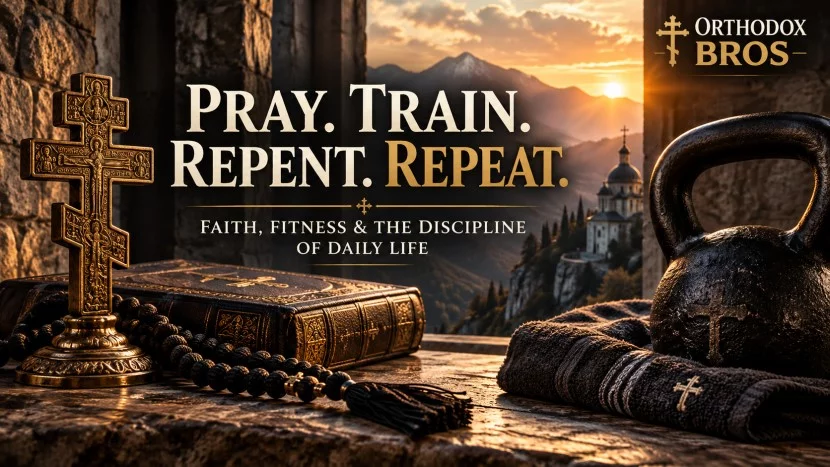
There is something wonderfully simple about the words Pray. Train. Repent. Repeat. Four short commands, each carrying a meaning far beyond the words themselves. They speak to the daily struggle to become better Christians, to care for the bodies we’ve been given, and to recognize that meaningful growth rarely happens without consistency, effort, and the willingness to begin again.
At first glance, prayer and physical training might seem like two entirely different pursuits. One belongs to the spiritual life, while the other involves muscles, endurance, movement, and physical health. Yet anyone who has seriously attempted either knows how easily good intentions can fade. We begin enthusiastically, encounter distractions or discomfort, fall short of our expectations, and eventually face a decision: abandon the effort or return to it.
For Orthodox Christians, this pattern should sound familiar. The spiritual life is not a brief season of enthusiasm followed by a comfortable arrival at holiness. It is a lifelong journey of prayer, worship, repentance, humility, and love. Our physical lives unfold alongside that journey, with their own responsibilities and limitations. We may be working to regain lost strength, improve mobility, establish healthier habits, or simply remain active enough to enjoy the years ahead.
The Orthodox Bros philosophy brings these interests together without confusing their purposes. Physical training can strengthen the body, but only God’s grace transforms the soul. Exercise is not a substitute for prayer, and a disciplined workout schedule does not make someone spiritually advanced. Nevertheless, a thoughtful approach to health can support a fuller, more active life of service to God, family, and neighbor.
That is what Pray. Train. Repent. Repeat. means to us. It is not a promise of perfection. It is a reminder to live intentionally, to acknowledge our weaknesses, and to keep moving forward with humility.
Pray: Begin With What Matters Most
Before the weights, the workout plans, the schedules, and the goals, there is prayer. For Orthodox Christians, prayer is not simply an encouraging thought offered before tackling the day’s responsibilities. It is an essential part of communion with God, a way of turning our hearts and minds toward the One who gives meaning to everything else we do.
In our modern world, attention is constantly being pulled in different directions. Phones buzz before our feet touch the floor. News, messages, work, and obligations compete for our concentration. It is remarkably easy to spend the first hour of the morning reacting to the world without giving even a few quiet minutes to God. We may tell ourselves that we’ll pray later, when things settle down, but the day seldom becomes less demanding on its own.
A simple, sustainable prayer rule can help us resist that pattern. Orthodox Christians have a rich inheritance of morning and evening prayers, Psalms, the Jesus Prayer, and the worship of the Church. The particular rule should be appropriate to the individual, ideally established with guidance from a parish priest or spiritual father. Someone beginning a regular prayer life does not need to imitate the schedule of a monastery. Faithful attention to a manageable rule is more valuable than an ambitious routine quickly abandoned.
One of the best-known expressions of Orthodox prayer is the Jesus Prayer: Lord Jesus Christ, Son of God, have mercy on me, a sinner. Its words are simple enough to remember, yet they contain an extraordinary depth of Christian faith. The prayer acknowledges Jesus Christ as Lord and Son of God while expressing our dependence upon His mercy. Orthodox Christians often use a prayer rope to help maintain attention, although the rope itself has no special power apart from the prayerful life of the person using it.
There is also an important distinction between praying regularly and turning prayer into another performance metric. We live in a culture that counts nearly everything: steps taken, calories burned, hours slept, pounds lifted, and personal records achieved. These measurements can be useful for physical goals, but prayer is not a competition. We cannot judge the condition of a soul by the number of repetitions someone completes or the length of time spent standing before an icon.
Prayer should gradually shape the way we approach the rest of the day. It can remind us to be patient when our plans are interrupted, to show mercy when someone irritates us, and to remember those who are suffering. The goal is not to retreat into a private world of spiritual accomplishments. It is to become more attentive to God and more loving toward the people around us.
And that includes how we approach physical training.
Train: Strength With Purpose
The human body is an extraordinary gift, but it is not immune to the effects of neglect, age, illness, or inactivity. Muscles weaken when we stop using them. Stiffness can make ordinary movement uncomfortable, and tasks that once required little thought may gradually become more difficult. While nobody can prevent every physical problem, most of us can take reasonable steps to preserve or improve our strength, mobility, and general fitness.
For an Orthodox Christian, caring for the body does not have to be an exercise in vanity. There is a meaningful difference between wanting to look impressive and wanting to remain capable. Being able to carry groceries, work around the house, climb stairs comfortably, enjoy an afternoon outdoors, or help a friend move something heavy can make everyday life easier. Maintaining physical ability can also preserve independence and allow us to continue participating in the activities and responsibilities we value.
This becomes especially important as we get older. The way someone trains at twenty-five may be entirely inappropriate at sixty-five, but the need for movement does not disappear with age. A person might once have enjoyed heavy lifting, martial arts, or competitive sports and later discover that walking, resistance bands, moderate weights, and mobility exercises provide a better fit. There’s no shame in adapting. Good training should serve the person we are today, not an imagined version of ourselves from decades ago.
The same principle applies to beginners. A modest strength-training routine performed consistently can be far more useful than an elaborate program that leaves someone exhausted, discouraged, or injured. Learning proper movement, increasing effort gradually, and allowing adequate recovery are signs of sound judgment. There is nothing admirable about ignoring pain or treating injury as proof of commitment. Physical discipline should develop capacity rather than recklessly destroy it.
Christian teaching also provides an important sense of perspective. Saint Paul uses athletic imagery in his letters to illustrate self-control, perseverance, and purposeful effort. Yet he does not present athletic achievement as the ultimate goal of human existence. In 1 Timothy 4:8, he distinguishes the limited benefits of bodily training from the far greater significance of godliness. That distinction matters. Our workouts may improve health and strength, but they cannot replace the spiritual life.
There is a practical lesson here for anyone whose fitness routine has become all-consuming. If every conversation revolves around the gym, every meal becomes a calculation, and every missed workout produces anger or anxiety, it may be worth asking whether training is serving its proper purpose. A healthy body is good. An obsession with the body can become another form of bondage.
At Orthodox Bros, we believe training is most meaningful when it helps us become more capable of living well and serving others. Strength is useful when it is accompanied by patience. Endurance matters when it allows us to fulfill responsibilities without unnecessarily giving up. Discipline has value when it teaches us to make wise choices, not when it turns us into harsh judges of ourselves or others.
Training with purpose means understanding both the benefits and the limits of physical strength. It means working hard when appropriate, resting when necessary, and remembering that the person beside us deserves respect regardless of age, appearance, size, or ability.

Repent: The Courage to Begin Again
Of the four words in our motto, repent may be the most important and the most easily misunderstood.
In everyday conversation, repentance is often associated almost entirely with guilt or regret. Someone does something wrong, feels terrible about it, and hopes the feeling will eventually fade. Orthodox Christianity teaches something much deeper. The Greek word metanoia, commonly translated as repentance, conveys a turning or change of mind, a reorientation of life toward God. It is not simply feeling bad about the past. It involves acknowledging our sins, seeking God’s mercy, and changing the direction in which we are living.
That distinction offers a powerful response to the discouragement that affects both spiritual and ordinary life. We all fall short of our intentions. Perhaps we lose our temper with someone we love, allow resentment to build, neglect prayer, or become consumed by distractions. Perhaps we also abandon an exercise program, slip into unhealthy routines, or repeatedly postpone changes we know would benefit us. These failures are not identical in seriousness or meaning, but they do reveal something about human weakness: resolutions alone do not guarantee transformation.
Repentance is not the declaration that we have become worthless because we failed. Nor is it permission to excuse harmful behavior with a casual promise to improve tomorrow. It calls for honesty and action. When we have wronged someone, we should seek forgiveness and make appropriate amends. When a destructive habit has gained power over us, we should acknowledge it and seek the help necessary to address it. In the sacramental life of the Orthodox Church, Confession provides a particular setting for repentance, healing, and reconciliation.
Physical training offers a much smaller, imperfect illustration of the importance of returning after a setback. Someone who misses a week of exercise has not erased every previous effort. A person recovering from illness may need to rebuild gradually, starting at a level that once seemed easy. The solution is seldom to punish the body with a brutal workout. Usually, it is to resume wisely and consistently, with patience for the circumstances that interrupted the routine.
The spiritual life requires even greater care because repentance cannot be reduced to a self-improvement strategy. We do not repent merely to become more efficient, confident, or successful. We repent because we need God’s mercy and because our sins damage our relationships with Him and with other people. Repentance is inseparable from humility, forgiveness, and the desire to love more faithfully.
There is an important difference between recognizing a weakness and building an identity around failure. A person who says, “I have sinned, and I need to change,” is moving toward something. A person who says, “I have failed, so there is no point in trying,” may be surrendering to despair. The Orthodox Christian response is to return to Christ, seek guidance where needed, and begin again without pretending that the struggle has disappeared.
This is why repentance belongs at the center of the Orthodox Bros message. We can value strength and healthy living while freely acknowledging that none of us has everything figured out. The most physically impressive person in a room may still need to learn patience and kindness. The most experienced Christian may still struggle with anger, judgment, or distraction. The work of repentance does not end when someone reaches a milestone, earns recognition, or develops an admirable routine.
We remain people in need of mercy.
Repeat: Why Consistency Matters More Than Excitement
Anyone who has spent time in a gym knows that enthusiasm is unreliable. A new program can feel exciting for the first few days, particularly when we’ve purchased new equipment or decided to pursue an ambitious goal. Eventually, however, the novelty wears off. There are mornings when the weather is unpleasant, evenings when we’re tired, and stretches of life when progress seems frustratingly slow.
The people who maintain healthy habits over many years are not necessarily those who feel the most motivated. Often, they are simply the ones who have learned how to keep a reasonable routine going through changing circumstances. They adjust their expectations when necessary, recover from setbacks, and understand that ordinary days matter just as much as memorable achievements.
Something similar can be said about the practice of prayer, although the spiritual purpose is entirely different. We should not wait for extraordinary feelings before praying. Some days our minds are attentive and our hearts are peaceful; on others, distractions seem endless. A regular prayer rule gives us a way to return our attention to God without depending upon our emotional state. The point is not mechanically accumulating prayers but faithfully making room for them.
This is one reason the word repeat belongs at the end of our motto. It is a reminder that tomorrow offers another opportunity. We pray again because we need God’s presence in our lives. We train again because our bodies benefit from appropriate, regular movement. We repent again because we continue to fall short, and we return again because growth is seldom completed in a single dramatic moment.
There is also freedom in accepting the ordinary nature of this work. We do not need every week to produce a major breakthrough. Some of the most meaningful changes appear quietly, over months and years. A difficult movement becomes easier. A walk that once felt exhausting becomes enjoyable. We discover that we’re responding more patiently to a situation that previously provoked anger. We remember to pray when we would once have reached automatically for another distraction.
Such changes are difficult to capture in a dramatic social media post, but they can make a genuine difference in everyday life. The important thing is to remain attentive to their purpose rather than becoming consumed by the desire to measure or display them.
Orthodox Fasting Is Not a Fitness Diet
Any serious discussion of Orthodox Christian discipline should acknowledge fasting, because it is an important part of the Church’s spiritual tradition. Unfortunately, fasting is sometimes discussed in modern fitness circles as though it were primarily a method of reducing calories or changing body composition. That is not the purpose of Orthodox fasting.
Orthodox fasting is connected to prayer, repentance, self-restraint, and generosity. The Church’s fasting seasons and customary fasting days invite us to examine our attachments and direct more attention toward God and the needs of others. Abstaining from certain foods is part of this larger spiritual effort, not a technique for demonstrating toughness. A person can follow every dietary restriction and still miss the point by becoming irritable, judgmental, or indifferent to those in need.
Fasting practices also require pastoral wisdom. Health conditions, medications, pregnancy, advanced age, demanding physical work, and other circumstances can make particular restrictions unsuitable. Anyone facing those concerns should discuss an appropriate practice with their priest and, when necessary, a healthcare professional. A fitness-oriented Orthodox Christian should never treat unnecessary physical harm as evidence of spiritual achievement.
There is no conflict in recognizing that bodies need adequate nourishment and that spiritual fasting serves a different purpose from athletic nutrition. The wise approach is neither to ignore the Church’s tradition nor to impose an extreme routine on oneself without guidance. It is to seek a faithful, sustainable way of participating in the life of the Church while responsibly caring for one’s health.
Most importantly, fasting should make us more compassionate, not less. If our discipline leaves us with greater contempt for those who practice differently, something essential has been lost. Prayer, fasting, and generosity belong together, and none should become a public performance of personal superiority.
Brotherhood: Nobody Has to Walk Alone
The word brotherhood appears prominently in the Orthodox Bros name for a reason. Although spiritual growth requires personal responsibility, Christianity is not a solitary pursuit. We worship together, pray for one another, share burdens, celebrate blessings, and rely upon the wisdom of people who have traveled difficult roads before us. Orthodox parish life brings together individuals of different ages, backgrounds, personalities, and levels of experience, reminding us that the Church is much more than a collection of private spiritual projects.
Fitness can benefit from community as well. An encouraging training partner can make it easier to establish a routine, particularly when motivation fades. An experienced friend might help a beginner avoid mistakes, while someone recovering from illness may appreciate a companion willing to walk at a slower pace. The strongest person in a group is not necessarily the one who lifts the most weight. Sometimes the greatest strength belongs to the individual who notices another person’s difficulty and quietly offers assistance.
True brotherhood is not built around appearance, status, or the ability to impress others. It grows through reliability, loyalty, generosity, and a willingness to show up when help is needed. Nor is that spirit limited to men. The values behind Orthodox Bros—faith, discipline, service, and mutual encouragement—are meaningful across the entire Christian community. Family members, friends, training partners, parishioners, and neighbors can all help one another live more intentionally.
This is a particularly important lesson in a culture where fitness is often presented as an individual competition. Comparing bodies, incomes, accomplishments, or lifestyles rarely produces the kind of community we actually need. Encouraging someone who is struggling, sharing useful knowledge without condescension, and celebrating another person’s progress are far better uses of our energy.
There will be seasons when we’re the ones offering help and others when we need to receive it. Aging, injury, grief, financial difficulty, and family obligations eventually remind nearly everyone of their limitations. Brotherhood gives us a way to meet those realities without pretending to be invincible.
Strength becomes more meaningful when it is placed in the service of love.
Building a Daily Rhythm of Faith and Fitness
So how do we put these ideas into practice without turning everyday life into an exhausting schedule of obligations? The answer begins with modest expectations. Rather than attempting to transform every habit overnight, choose a few realistic practices and give them enough consistency to become part of ordinary life.
Start the morning with prayer. Before becoming absorbed in messages and news, make time for the morning prayers appropriate to your rule. That might mean a few quiet minutes before the household wakes or a slightly longer period later in the morning. The schedule matters less than approaching prayer with sincerity and giving it a regular place in your day.
Make movement part of your routine. For some people, that will mean strength training several times a week. Others may benefit from walking, swimming, cycling, mobility work, or a carefully planned rehabilitation program. Choose activities suited to your health and abilities, and resist the temptation to measure success solely by intensity. A sustainable routine that helps you remain active is a much better foundation than an impressive plan you cannot maintain.
Practice repentance throughout the day. Pay attention to how you speak to others, respond to frustration, and handle your responsibilities. When you recognize that you’ve acted wrongly, acknowledge it rather than defending yourself automatically. Seek forgiveness when appropriate and turn to God in prayer. These ordinary moments of self-examination can reveal more about our spiritual condition than the image we present to the world.
Protect time for worship, relationships, and rest. A workout that repeatedly displaces church attendance, family obligations, sleep, or important responsibilities may need to be reconsidered. Likewise, a spiritual routine should not be used as an excuse to neglect practical duties. Our daily lives involve competing needs, and wisdom means recognizing how those responsibilities fit together without making one pursuit an idol.
Finally, allow yourself to adapt. Some weeks will be demanding, and some seasons of life will require very different priorities. Illness, new responsibilities, injury, and aging can change what is possible. A person who can no longer train as intensely as before has not lost the ability to live with purpose. Prayer, patience, kindness, gratitude, and service remain available in circumstances where physical accomplishments may no longer be possible.
The goal is not a flawless schedule. It is a faithful way of living.
Wearing a Message That Means Something
At Orthodox Bros, our apparel designs are intended to carry messages worth considering. We appreciate the beauty of traditional Orthodox crosses and the history represented by Christian symbols, but we also want our clothing to express something about everyday life. That is why the words Pray. Train. Repent. Repeat. became part of our collection.
The message is intentionally direct. Prayer reminds us where our attention belongs. Training encourages responsible care for the body. Repentance calls us to recognize our weaknesses and return to Christ. Repetition acknowledges that these are not occasional interests but continuing parts of a life lived with intention.
Our Pray. Train. Repent. Repeat. workout tanks are available in Black and White for those who appreciate the connection between Orthodox Christian faith and physical discipline. The design works as a reminder in the gym, during a walk, or throughout an ordinary day. It may even begin a conversation about what those four words mean.
Of course, no shirt can make someone more faithful, and no design can replace the actions it describes. Clothing is simply a way of expressing a message. The real meaning is found in the lives we try to lead.
You can explore these designs and the rest of our Orthodox Christian apparel collection.
The Real Work Begins Tomorrow
There is no shortage of advice promising immediate results. Whether the subject is fitness, productivity, or personal development, we’re constantly encouraged to search for the next breakthrough, the perfect formula, or the shortcut that changes everything. Orthodox Christianity reminds us that the most important work of a human life does not fit comfortably into that way of thinking.
We are called to prayer, repentance, worship, mercy, and love. We also have practical responsibilities toward our bodies, families, and communities. Some of those duties are difficult, others are repetitive, and many receive little recognition. Yet they remain valuable precisely because they are woven into the fabric of ordinary life.
Perhaps you missed your workout today. Perhaps your prayer rule has become inconsistent, or you recognize that you’ve been impatient, distracted, or unkind. The answer is not to invent a dramatic new identity by tomorrow morning. Begin with what is in front of you. Say your prayers. Make amends where you can. Take a walk or complete an appropriate workout. Encourage someone who needs it.
Then do it again.
Not because every day will be exceptional. Not because consistency makes us worthy of God’s love. And certainly not because physical strength offers a shortcut to holiness.
We continue because caring for the body is worthwhile, returning to prayer is necessary, and repentance remains part of the Christian life. We continue because God’s mercy is greater than our failures and because the people around us benefit when we strive to become more patient, capable, and generous.
Pray. Train. Repent. Repeat.
Ancient Faith. Modern Brotherhood.
Faith. Strength. Brotherhood.
Continue Exploring Orthodox Bros
Discover our Fitness & Strength philosophy, browse the Orthodox Bros Shop, or explore more articles in the Orthodox Bros Journal.