Ancient Faith. Modern Brotherhood.
If you’ve ever visited an Orthodox Christian church, you’ve probably noticed that the crosses don’t always look quite like the ones you’re accustomed to seeing. Some have three horizontal bars, with the bottom one tilted at an unusual angle. Others have beautifully ornamented arms, elaborate inscriptions, or the familiar figure of Christ depicted in a style that looks distinctly different from Western Christian artwork. You may have seen these crosses on church domes, hanging from necklaces, incorporated into icons, or embroidered onto vestments. They’re immediately recognizable, yet the details can leave even longtime Christians wondering what everything means.
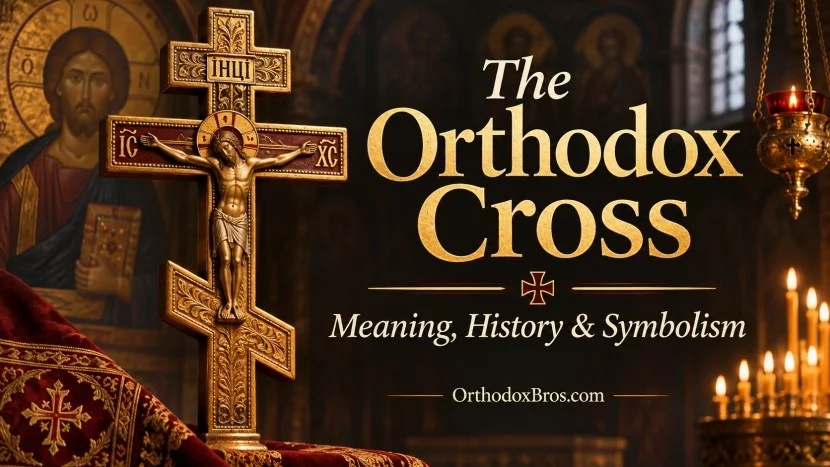
The most familiar example is often called the Russian Orthodox cross or eight-pointed cross. With its short upper bar, longer central crossbeam, and slanted lower footrest, it has become one of the most recognizable symbols associated with Eastern Orthodox Christianity. But there’s an important detail that often gets overlooked: Orthodox Christians don’t use just one style of cross. The traditions of Greece, Russia, Serbia, Romania, Georgia, Ukraine, and other Orthodox cultures include a remarkable variety of designs, some dating back many centuries.
Those differences aren’t simply decorative. The shapes, inscriptions, and artistic traditions surrounding the Orthodox cross communicate important aspects of Christian belief, particularly the Crucifixion and Resurrection of Jesus Christ. Understanding them provides a glimpse into the theology, history, and worship of a Church that has preserved these symbols across generations.
In this guide, we’ll explore what makes the Orthodox cross distinctive, why the three-bar cross has a slanted footrest, how different designs developed, and what these symbols mean in the lives of Orthodox Christians today. We’ll also separate established history from traditional interpretations, because not every explanation repeated on the internet has the same historical foundation.
What Does the Orthodox Cross Represent?
Before examining different shapes and styles, it’s worth considering what the cross represents in Orthodox Christianity. At its center is a truth that can be easy to overlook precisely because the cross has become so familiar. In the Roman world, crucifixion was a brutal method of execution associated with suffering, humiliation, and public disgrace. It was hardly the sort of object anyone would naturally choose as a symbol of hope. Yet Christianity transformed the meaning of the cross by proclaiming that Jesus Christ, through His voluntary suffering, death, and Resurrection, brought about humanity’s salvation.
For Orthodox Christians, the Crucifixion cannot be separated from the Resurrection. The cross is not merely a reminder of a terrible event in the past, nor is it simply a decorative emblem identifying someone as Christian. It points toward Christ’s sacrificial love, His victory over sin and death, and the hope of eternal life. This is why Orthodox tradition frequently refers to the Precious and Life-Giving Cross, a description that may initially seem unusual when applied to an instrument of execution.
The Apostle Paul addresses this apparent contradiction in 1 Corinthians 1:18, where he describes the message of the Cross as foolishness to those who are perishing but the power of God to those being saved. What appears to the world as defeat becomes, through Christ, the means of victory. That understanding runs throughout Orthodox theology, hymnography, iconography, and worship.
It’s also why the cross occupies such a prominent place in Orthodox Christian life. You’ll encounter it above church entrances, on altar furnishings, in homes, and in personal devotional objects. Orthodox Christians make the sign of the cross during prayer, venerate the cross during important services, and frequently wear a small cross as a reminder of their faith. These practices aren’t intended to direct worship toward an object. Their purpose is to turn our attention toward Christ and the saving work represented by the cross.
Why Does the Orthodox Cross Have Three Bars?

The three-bar cross is especially associated with Russian and other Slavic Orthodox traditions. Its distinctive appearance comes from a vertical shaft intersected by three separate crosspieces, each traditionally connected with an aspect of Christ’s Crucifixion. Although the individual elements are relatively simple, they combine to create a symbol carrying several layers of meaning.
The Upper Bar: The Inscription Above Christ
The short upper crossbar represents the inscription placed above Jesus during His Crucifixion. According to John 19:19, Pontius Pilate ordered a title identifying Jesus of Nazareth as King of the Jews. The Gospel also describes the inscription as being written in Hebrew, Latin, and Greek, reflecting the languages encountered in the region at that time.
In Western Christian artwork, the inscription is frequently abbreviated as INRI, derived from the Latin Iesus Nazarenus Rex Iudaeorum. Orthodox depictions may use different linguistic forms, including Greek or Church Slavonic inscriptions, and sometimes the title King of Glory.
This upper bar serves as a reminder of the extraordinary contrast between the mockery surrounding Christ’s execution and the Church’s confession that He truly is King. The title that was intended to identify a condemned man becomes, within Christian belief, a proclamation far greater than those who placed it there could have understood.
The Middle Bar: The Main Crossbeam
The long central bar represents the primary crossbeam associated with Christ’s outstretched arms. It is the most familiar feature of almost every traditional Christian cross, whether the design is Greek, Latin, Slavic, or Byzantine.
Within Orthodox theology, the outstretched arms of Christ are frequently understood as an expression of divine love extending to the world. The imagery reminds believers that the Crucifixion was not simply an act of violence inflicted upon an innocent man, but part of Christ’s voluntary sacrifice for the salvation of humanity.
The central crossbeam also connects the three-bar Orthodox cross to the broader Christian tradition. Whatever differences appear in regional artwork, the central event being remembered remains the same: the Crucifixion of Jesus Christ.
The Lower Bar: Christ’s Footrest
The third and lowest crosspiece represents a footrest, sometimes called the suppedaneum. In many familiar Slavic Orthodox designs, this bar is angled rather than horizontal, creating the distinctive appearance associated with the eight-pointed cross.
It’s important to understand that the footrest belongs to the traditional visual representation of the Crucifixion. We cannot establish the exact physical arrangement of Christ’s historical cross from the Gospel accounts alone. The symbolism developed through Christian artistic and devotional traditions rather than through a preserved technical drawing of the original instrument.
Earlier Byzantine representations frequently depicted the lower bar horizontally. The slanted version became particularly familiar in Russian and other Slavic Orthodox traditions, eventually taking on the additional spiritual interpretations that are widely discussed today.
That slanted footrest is often the first detail people notice, and its meaning deserves a closer look.
Why Is the Bottom Bar of the Orthodox Cross Slanted?
Among the most familiar interpretations of the tilted lower bar is its association with the two criminals crucified alongside Jesus. The Gospel of Luke describes one criminal mocking Christ, while the other acknowledges his own wrongdoing, recognizes Christ’s innocence, and asks Jesus to remember him in His Kingdom. Christ responds with the promise that the repentant criminal will be with Him in Paradise (Luke 23:39–43).
Within a common Slavic Orthodox interpretation, the upward-pointing end of the footrest represents the repentant thief who received Christ’s promise of Paradise. The downward-pointing end is associated with the other thief, who continued to reject Him. In conventional depictions, the raised end is generally on Christ’s right side, which appears on the viewer’s left when looking directly at the cross.
The symbolism is powerful because it places repentance and the possibility of salvation before everyone who sees the cross. Two men were suffering similar punishments, yet they responded to Christ in profoundly different ways. One remained hardened in mockery, while the other recognized his wrongdoing and turned toward Christ even in the final moments of his life. For Orthodox Christians, the image serves as a reminder of the importance of humility, repentance, and responding to God’s mercy.
However, this traditional explanation should not be confused with a fully documented account of how the slanted crossbar first appeared. The Orthodox Church in America notes that the precise historical origin of the slant is uncertain and that earlier Byzantine depictions frequently used a horizontal footrest. Various devotional interpretations developed over time, with the two thieves becoming one of the most familiar explanations.
Recognizing that distinction doesn’t diminish the symbolism. It simply helps us approach the tradition accurately, appreciating its spiritual meaning without turning a later interpretation into an unsupported historical claim.
The Different Types of Orthodox Christian Crosses
One common misconception is that a cross must have three bars to be considered Orthodox. In reality, the Orthodox Church has used a variety of cross forms throughout its history, and different regional traditions have developed distinctive artistic preferences.
The Greek cross, for example, has four arms of approximately equal length. Its balanced shape appears throughout Byzantine Christian art, church architecture, icons, liturgical objects, and decorative ornamentation. Some examples are remarkably simple, while others feature elaborate borders, flared ends, inscriptions, or precious materials. A Greek cross may look quite different from the familiar Slavic three-bar cross, but it remains entirely appropriate within Orthodox Christian tradition.
The Byzantine tradition also includes highly ornamented crosses, sometimes featuring widened or flared arms, decorative terminals, and inscriptions such as IC XC NIKA. Certain forms became associated with imperial Christianity, church furnishings, and sacred artwork. Over the centuries, Byzantine artisans developed a rich visual vocabulary in which the shape of a cross could be combined with theological inscriptions, precious metals, colorful enamel, and symbolic ornamentation.
Another traditional form is the patriarchal cross, which features two horizontal bars. The shorter upper bar is associated with the inscription above Christ, while the longer bar represents the principal crossbeam. This type has appeared in different Christian traditions and shouldn’t be treated as exclusively Orthodox.
The three-bar cross, sometimes called the Russian Orthodox cross or eight-pointed cross, became especially prominent in Slavic Christianity. The reference to eight points describes the visible ends of its crosspieces and vertical shaft, not a separate theological requirement. Its appearance on churches, monuments, and devotional objects has made it one of the most recognizable symbols of Russian Orthodox heritage.
There are also regional crosses associated with Georgian, Serbian, Romanian, and other Orthodox artistic traditions. Some preserve extremely old forms, while others reflect local craftsmanship and historical influences. The variety is one of the interesting features of Orthodox Christian material culture: a shared faith expressed through different visual languages.
For anyone interested in Orthodox crosses, the most important thing to remember is that the particular shape doesn’t determine whether a Christian is genuinely Orthodox. The meaning of the Cross rests in Jesus Christ, not in the number of decorative bars or the national tradition from which a design originated.
The History of the Cross in Orthodox Christianity
The cross did not become the central public symbol of Christianity overnight. The earliest Christians lived within a Roman world in which crucifixion was associated with shame and punishment, and early Christian art used several symbols to express faith in Christ. The fish, the Chi-Rho monogram, the Good Shepherd, and other images appeared in Christian settings as the Church developed its artistic language.
By the fourth century, circumstances had changed considerably. The reign of Emperor Constantine and the legalization of Christianity helped create new opportunities for public Christian worship and architecture. Crosses and Christograms became increasingly visible in imperial and ecclesiastical settings, while the construction of major churches gave Christian art a new prominence.
One important part of Orthodox tradition concerns Saint Helen, the mother of Emperor Constantine, and the discovery of the True Cross in Jerusalem. According to the Church’s traditional account, Helen traveled to the Holy Land during the fourth century and participated in the search for sites associated with Christ’s earthly life, Crucifixion, and burial. The discovery of the Cross became an important event in Christian memory and eventually formed part of the celebrations associated with the Feast of the Exaltation of the Holy Cross.
The stories surrounding Helen’s discovery include miraculous elements preserved in the Church’s devotional tradition. They should be presented as part of that tradition rather than treated as independently verifiable archaeological findings in every detail. What can be said with confidence is that the veneration of the Cross became deeply established in Byzantine Christian life and remained central to Orthodox worship.
As Christianity spread into Slavic lands and other regions, established Byzantine religious traditions encountered local artistic and cultural influences. Cross designs developed distinctive regional characteristics while preserving their underlying Christian meaning. The familiar Russian three-bar cross belongs to that broader history, reflecting centuries of Christian artistic development rather than a completely separate theology of the Crucifixion.
Today, Orthodox crosses appear in forms ranging from simple wooden devotional objects to monumental crosses atop churches. The materials and artistic styles vary enormously, but the essential message continues to connect believers with the Church’s proclamation of Christ’s death and Resurrection.
The Orthodox Cross and the Meaning of IC XC NIKA
If you’ve examined Byzantine-style crosses, you’ve probably encountered four groups of Greek letters arranged around the arms: IC XC NIKA.
This traditional inscription means Jesus Christ Conquers, or Jesus Christ Is Victorious. The letters IC and XC are abbreviations of the Greek names for Jesus Christ, while NIKA expresses victory. Together, they proclaim Christ’s triumph over sin and death through His Crucifixion and Resurrection.
The inscription appears in several forms of Orthodox Christian artwork, including icons, crosses, and liturgical objects. It is particularly meaningful when placed around the cross because it connects Christ’s suffering directly with the victory proclaimed by the Church.
That victory isn’t understood as the kind of worldly triumph we usually associate with military power, financial success, or athletic competition. It concerns Christ’s saving work and His victory over death. This distinction is important because modern culture often uses the language of conquering and victory in ways that emphasize personal dominance. Orthodox Christianity directs that language toward Christ and the hope of salvation.
We’ve explored this inscription in much greater detail in our article, What Does IC XC NIKA Mean? The History and Meaning of Christ Conquers. If you’re interested in Orthodox symbolism, it’s a useful companion to understanding the different forms of the cross.
The Sign of the Cross in Everyday Orthodox Christian Life
The Orthodox cross isn’t only something Christians look at or wear. It is also something they make upon themselves in prayer, a practice deeply embedded in the worship and daily life of the Church.
In the common Orthodox manner of making the sign of the cross, the thumb, index finger, and middle finger of the right hand are brought together. These three fingers symbolize the Holy Trinity: Father, Son, and Holy Spirit. The remaining two fingers are folded toward the palm, traditionally representing the divine and human natures of Jesus Christ.
The hand is then moved from the forehead to the lower chest or abdomen, followed by the right shoulder and then the left. The gesture is a physical expression of Christian faith, a prayerful acknowledgment of the Trinity and of Christ’s saving work.
Visitors to Orthodox churches often notice that the faithful make the sign of the cross at various moments during services. You may see people crossing themselves when the Trinity is invoked, before venerating an icon, during particular prayers, or when entering a church. Practices can vary in their details, but the underlying purpose is to unite the physical gesture with attention, reverence, and prayer.
It can be easy to treat something repeated frequently as little more than a habit. Yet the sign of the cross is meant to call the believer back to conscious remembrance of Christ. Its importance doesn’t depend on making an impressive gesture or drawing attention to oneself. Quite the opposite: it is an ordinary, humble act that can help direct the heart and mind toward God.
This is one example of how Orthodox Christianity involves the whole person. The spiritual life isn’t understood as something confined entirely to private thoughts. Standing, bowing, kneeling, crossing oneself, fasting, and participating in the liturgical life of the Church are ways in which the body participates in worship.
Why Orthodox Christians Venerate the Cross
To someone unfamiliar with Orthodox Christianity, seeing believers bow before or kiss a cross can seem unusual. Understanding the distinction between worship and veneration helps explain the practice.
Orthodox Christians worship God alone. When they venerate the Cross, they are expressing reverence for Christ and the saving work associated with His Crucifixion. The respect shown toward the symbol is directed ultimately toward the One whom it represents, not toward wood, metal, or another material as though it possessed independent divine power.
The Church gives particular attention to the Cross at several points during the liturgical year. One of the most important occasions is the Feast of the Universal Exaltation of the Precious and Life-Giving Cross, celebrated on September 14. The feast commemorates traditions concerning the finding and elevation of Christ’s Cross and invites believers to reflect upon the meaning of the Crucifixion.
Another important observance takes place on the Third Sunday of Great Lent, known as the Sunday of the Veneration of the Holy Cross. Positioned near the middle of the Lenten journey, this commemoration encourages the faithful to persevere as they approach Holy Week and Pascha. The Cross is placed before the congregation as a reminder that the difficulties of repentance and spiritual discipline must be understood in the light of Christ’s saving love.
These observances demonstrate that the Cross is not simply an architectural decoration or an identifying emblem. It remains central to the living worship of the Orthodox Church.
Wearing an Orthodox Cross: Faith, Tradition, and Personal Responsibility
Many Orthodox Christians wear a small cross as part of their personal religious life. In Orthodox tradition, receiving a cross is commonly associated with Baptism, and wearing it can serve as a continuing reminder of one’s commitment to Christ. The design may be simple or elaborate, depending on family tradition, local custom, and personal circumstances.
But wearing an Orthodox cross isn’t a substitute for living the Christian faith. A beautiful pendant, an intricately decorated icon, or a shirt featuring traditional symbolism may express something meaningful, yet none of these objects automatically makes a person more faithful, humble, or spiritually mature. Their value lies partly in their ability to remind us of responsibilities that extend far beyond outward appearance.
This matters particularly when traditional religious imagery becomes popular outside its original context. Orthodox crosses have become increasingly visible in jewelry, clothing, online culture, and contemporary design. Some people are genuinely drawn toward learning about Orthodox Christianity, while others simply find the historical artwork attractive. The interest itself can create opportunities for conversation, but the symbols deserve to be treated with care and respect.
At Orthodox Bros, our interest in the Cross begins with its spiritual meaning. We appreciate the beauty of Byzantine artwork and the distinctive visual traditions of Orthodox Christianity, but those artistic qualities aren’t the entire story. The Cross represents Christ’s sacrifice, His victory over death, and the continuing call to humility, repentance, and love.
Our IC XC NIKA Christ Conquers Tee incorporates a Byzantine-inspired gold cross design with the traditional proclamation of Christ’s victory. Our Signature Gold Cross Hoodie takes a more understated approach, combining a gold Orthodox cross emblem with contemporary everyday apparel.
We don’t believe clothing creates faith. What it can do is express an existing conviction, encourage a thoughtful conversation, or offer a simple reminder of something that matters. For us, the message behind the design should always remain more important than the design itself.
What the Orthodox Cross Can Teach Us About Real Strength
For a brand built around faith, fitness, and brotherhood, the Orthodox cross provides a particularly important reminder about the meaning of strength.
Modern culture often defines strength through physical appearance, athletic performance, financial success, or the ability to impose one’s will upon others. Those measures can tell us something about a person’s capabilities, but they reveal relatively little about character. Someone can be extraordinarily powerful and still lack patience, compassion, or the ability to admit wrongdoing.
The Cross presents a profoundly different understanding of victory. Christ’s willingness to suffer, sacrifice, and forgive challenges the assumption that strength must always be expressed through domination. Within Orthodox Christianity, humility isn’t weakness, and compassion isn’t a failure of courage. The willingness to love others, accept responsibility, forgive, and remain faithful during hardship can demand tremendous strength of character.
This doesn’t mean physical fitness has no value. At Orthodox Bros, we encourage people to care responsibly for their health, develop useful physical abilities, and pursue training with patience and consistency. Strength, mobility, endurance, and practical fitness can all contribute to a healthier and more capable life. But those things should remain in their proper place.
The Cross reminds us that genuine spiritual maturity isn’t measured by how much weight we lift, how disciplined our training schedule appears, or how impressive we look in the mirror. A person who is physically limited may demonstrate extraordinary courage, faith, and love. Someone who is exceptionally athletic may still have much to learn about humility and service.
That distinction is central to our philosophy. We want physical training to complement a meaningful life rather than become its ultimate purpose. We want brotherhood to involve genuine support and responsibility rather than simply shared interests. Above all, we recognize that the Christian life is centered on Christ, not on personal accomplishments.
For a deeper discussion of those principles, read Faith, Fitness & Brotherhood: The Orthodox Bros Philosophy.
Frequently Asked Questions About the Orthodox Cross
Why Does the Orthodox Cross Have Three Crossbars?
The traditional three-bar Orthodox cross includes a short upper bar representing the inscription placed above Jesus, a longer central bar representing the primary crossbeam, and a lower bar representing the footrest. This form is particularly associated with Russian and other Slavic Orthodox traditions, although related forms appeared earlier in Byzantine Christianity.
What Does the Slanted Bottom Bar Mean?
A common traditional interpretation connects the slanted footrest with the two criminals crucified alongside Christ. The upward-pointing end represents the repentant thief who received Christ’s promise of Paradise, while the downward-pointing end is associated with the other thief. The precise historical origin of the slant is uncertain, so the interpretation should be understood as devotional symbolism rather than an established explanation of the original design’s invention.
Do All Orthodox Christians Use the Three-Bar Cross?
No. Orthodox Christianity includes several traditional cross designs, including Greek crosses, Byzantine ornamental crosses, patriarchal crosses, and Slavic three-bar crosses. Different regions and historical periods developed distinctive artistic preferences. The essential Christian meaning of the Cross does not depend on one particular shape.
What Does IC XC NIKA Mean on an Orthodox Cross?
IC XC NIKA means Jesus Christ Conquers or Jesus Christ Is Victorious. It is a traditional Greek inscription proclaiming Christ’s victory over sin and death. The inscription often appears around the arms of Byzantine-style crosses and on other Orthodox religious objects.
What Is the Difference Between an Orthodox Cross and a Catholic Cross?
The distinction is primarily one of commonly associated artistic and regional traditions, rather than an absolute separation between two exclusive shapes. The Latin cross is particularly familiar in Western Christianity, while the three-bar cross is strongly associated with Slavic Orthodoxy. Orthodox Christians also use simpler cross forms, and some designs appear in both Eastern and Western Christian history.
Why Do Orthodox Christians Wear Crosses?
Wearing a cross can serve as a reminder of Baptism, Christian faith, and the call to follow Christ. A cross is not intended to replace prayer, worship, repentance, or participation in the life of the Church. Its meaning comes from the person and saving work of Jesus Christ, not from the material or decoration of the object.
Final Thoughts: More Than a Religious Symbol
The Orthodox cross is one of Christianity’s most recognizable and meaningful symbols, yet its significance extends far beyond its distinctive appearance. Whether we’re looking at a simple Greek cross, an ornate Byzantine design, or the familiar three-bar Slavic cross with its slanted footrest, we’re encountering expressions of the same central Christian proclamation: Jesus Christ was crucified, rose from the dead, and opened the way to salvation.
The variety of Orthodox crosses reflects a long and fascinating history. Different cultures developed their own artistic traditions, craftsmen created beautiful devotional objects, and generations of believers preserved interpretations that continue to enrich the Church’s visual language. Some details have well-documented historical explanations, while others belong to the development of traditional devotional symbolism. Both can be appreciated without confusing one with the other.
Ultimately, though, understanding the Orthodox cross involves more than learning what its bars and inscriptions represent. It involves recognizing the challenge presented by the Cross itself. Christianity calls believers toward humility, repentance, self-denial, forgiveness, and love for others—qualities that don’t always receive much recognition in a world preoccupied with outward success.
At Orthodox Bros, we draw inspiration from those ancient traditions while encouraging a balanced approach to physical health, personal discipline, and meaningful brotherhood. Our goal isn’t to turn Christianity into a fashion statement or reduce profound theological ideas to attractive graphics. It’s to appreciate the meaning behind the symbols we use and encourage thoughtful conversations about the values they represent.
The shape of the Orthodox cross may vary, but the message at its heart remains unchanged: the victory belongs to Christ.
Ancient Faith. Modern Brotherhood.
Further Reading
For readers interested in exploring the history and theology of the Cross more deeply, these official Orthodox resources provide valuable background: