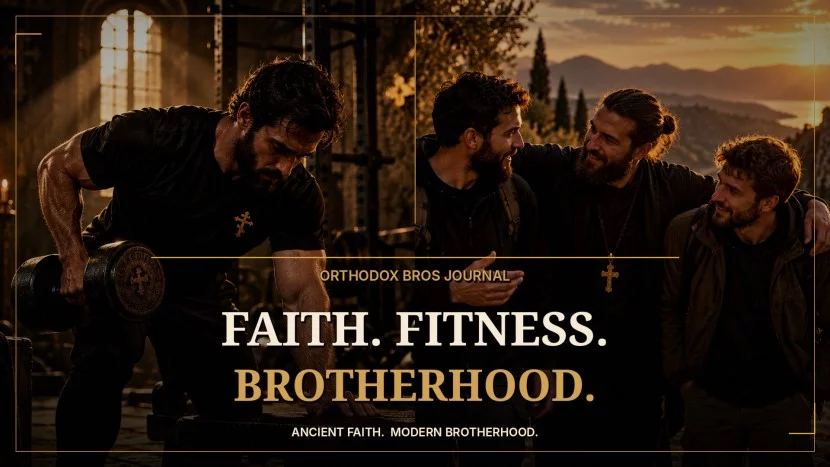
Ancient Faith. Modern Brotherhood. Discover how Orthodox Christianity, physical fitness, personal discipline, and genuine friendship can come together to create a more purposeful way of life.
There’s something deeply satisfying about becoming stronger. Whether it’s lifting a little more weight than you could last month, walking farther without getting tired, mastering a difficult martial arts technique, or simply noticing that everyday activities have become easier, physical progress can be tremendously rewarding. It reminds us that consistent effort matters and that meaningful improvement often comes from doing ordinary things repeatedly, even when we don’t particularly feel like doing them.
But somewhere along the way, it’s worth asking an important question: What are we actually trying to become stronger for?
Modern fitness culture has plenty of answers. Some people want bigger muscles, better athletic performance, improved health, or a more attractive appearance. Others enjoy the challenge of competition or the personal satisfaction of achieving difficult goals. There’s nothing inherently wrong with wanting to become healthier, stronger, or more capable. The problem begins when physical accomplishments become the foundation of our identity, or when the pursuit of strength encourages vanity, selfishness, and an unhealthy obsession with ourselves.
Orthodox Christianity offers a different perspective. It teaches us that our lives should be centered on Christ and that qualities such as humility, patience, self-control, compassion, and love for others matter far more than outward accomplishments. This doesn’t mean that physical fitness is unimportant or that caring for our bodies is somehow opposed to spiritual growth. Rather, it challenges us to understand physical health and personal discipline within the larger purpose of Christian living.
That’s the thinking behind Orthodox Bros. We believe that ancient Orthodox Christian faith has something meaningful to offer people navigating the challenges of modern life. We also believe that developing healthy habits, maintaining physical capabilities, and building genuine relationships can complement a life rooted in prayer, repentance, and service to others.
Our philosophy can be summarized in three words: Faith. Strength. Brotherhood.
Those words are easy to print on a shirt. Living by them is another matter entirely.
Ancient Faith in a Modern World

Orthodox Christianity isn’t a modern lifestyle movement or a philosophy assembled around whatever ideas happen to be popular. Its roots reach back to the earliest centuries of Christianity, preserving a rich inheritance of worship, theology, Scripture, iconography, and spiritual teaching. Through generations of profound social and political change, the Orthodox Church has continued to proclaim the Gospel and call believers toward a life of communion with God.
There’s something reassuring about that continuity. We live in a culture where ideas, fashions, and priorities can change almost overnight. One year we’re told that a particular diet is the answer to everything, and the next year an entirely different approach becomes fashionable. Fitness routines, motivational philosophies, and personal-development trends rise and fall with astonishing speed. What was considered essential yesterday may be dismissed as outdated tomorrow.
Orthodox Christian spirituality operates on a different timescale. Its central concerns aren’t determined by popularity or changing cultural preferences. Prayer, repentance, fasting, worship, humility, and love for our neighbors remain essential whether we’re living in the fourth century or the twenty-first.
This doesn’t mean Orthodox Christians should reject modern knowledge, technology, or practical improvements in everyday living. It means that these things should serve our lives rather than determine their ultimate purpose. Medical advances, sensible exercise, better nutrition, and practical approaches to maintaining health can all be valuable. None of them, however, can replace the spiritual life of the Church.
At Orthodox Bros, we aren’t interested in reinventing Orthodoxy to make it fashionable. The Christian faith doesn’t need a modern makeover to become relevant. What interests us is exploring how its enduring principles can guide people who are trying to live responsibly, care for their health, support their families, and build meaningful relationships in a complicated world.
That begins by recognizing an important truth: we aren’t simply minds or souls temporarily occupying bodies. We are whole human beings, and how we live matters.
Caring for the Body Without Worshiping It
Christianity has sometimes been misunderstood as teaching that the physical body is unimportant or inherently bad. That misunderstanding doesn’t reflect the Orthodox Christian view of the human person. The Church proclaims the Incarnation of Christ, honors the Resurrection, and understands human life as involving both body and soul.
In 1 Corinthians 6:19–20, the Apostle Paul reminds Christians that their bodies are temples of the Holy Spirit and calls them to glorify God in their bodies. The passage speaks primarily to moral and spiritual conduct, rather than prescribing an exercise program, but it certainly challenges the idea that what we do physically has no connection to our Christian lives.
Caring for our health can therefore be understood as an act of responsibility. Maintaining reasonable physical fitness may help us carry out everyday obligations, remain independent as we grow older, participate in activities we enjoy, and provide assistance to others when needed. Exercise can improve endurance, strength, balance, and general well-being. Just as importantly, it can help us retain capabilities that make ordinary life easier.
Consider how much of life depends on basic physical ability. Carrying groceries, climbing stairs, working in the yard, helping someone move furniture, or getting up from the floor are all things that can become more difficult when strength and mobility decline. Nobody needs to look like a competitive bodybuilder to appreciate the value of maintaining these abilities.
Of course, good health isn’t entirely within our control. Illness, injury, disability, age, and circumstances can limit what we’re physically capable of doing. A person who cannot exercise vigorously is not less disciplined, less valuable, or somehow failing in the Christian life. Sometimes caring responsibly for the body means rehabilitation, adequate rest, accepting assistance, or adapting to limitations rather than attempting to overcome everything through sheer determination.
The goal shouldn’t be to build a perfect physique. It should be to care for ourselves sensibly, appreciate the abilities we’ve been given, and use them responsibly. Physical health is a worthwhile pursuit, but it is not the measure of a person’s worth.
What Physical Training Can Teach Us About Discipline
Anyone who has spent years around weight training, martial arts, or another demanding physical discipline understands that progress rarely follows a perfectly straight line. Some workouts feel terrific, while others seem to accomplish very little. Techniques that initially appear simple can take years to refine, and even experienced practitioners discover weaknesses they hadn’t noticed before.
One of the most valuable lessons physical training offers is that improvement requires consistency. A single outstanding workout might leave you feeling accomplished, but it won’t accomplish what months or years of regular effort can produce. The same principle applies to learning a martial art. You can understand a technique intellectually after seeing it demonstrated, yet performing it naturally and reliably under pressure requires repeated practice.
That process teaches patience, or at least gives us plenty of opportunities to develop it. It also forces us to confront our limitations. No matter how experienced we become, there’s usually something we can improve. Sometimes the most useful lesson comes from discovering that a familiar method isn’t working as well as we believed.
There is a temptation, however, to take these similarities too far. Orthodox Christian spiritual discipline is not simply another form of athletic training, and holiness is not achieved by accumulating spiritual accomplishments the way someone adds weight to a barbell. Prayer isn’t a performance metric. Repentance isn’t a productivity technique. The spiritual life depends upon God’s grace and our continuing participation in the life of the Church.
Still, the habits learned through sensible physical training can provide useful illustrations of perseverance, patience, attentiveness, and consistency. They remind us that meaningful commitments rarely thrive when we give them attention only when circumstances are convenient.
In that sense, the gym can teach valuable lessons about our attitudes. Do we become impatient when progress slows? Do we refuse advice because we don’t like admitting mistakes? Are we willing to help a beginner, or do we treat someone else’s lack of experience as an opportunity to feel superior?
These questions reveal much more about our character than the numbers recorded in a training notebook.
Strength Without Arrogance
The pursuit of physical strength can develop confidence, and healthy confidence is not necessarily a bad thing. Knowing that you’re capable of completing a difficult task, protecting yourself from avoidable injury, or handling a physically demanding situation can be reassuring. Strength and skill may also help us remain calm under circumstances that would otherwise make us anxious.
But confidence can easily become arrogance when we begin confusing our abilities with personal superiority.
Spend enough time around experienced martial artists and you’ll encounter people with very different attitudes toward their abilities. Some are generous with their knowledge, patient with beginners, and perfectly comfortable acknowledging that they still have things to learn. Others become so concerned with protecting their reputation that they struggle to accept correction or admit a weakness.
The difference isn’t necessarily technical skill. It’s character.
One of the most valuable qualities in a genuinely accomplished instructor is the ability to remain a student. The same principle applies to physical training generally. A person who listens, learns, and treats others respectfully is often far more pleasant to train alongside than someone who constantly needs to demonstrate how impressive they are.
Orthodox Christianity takes humility seriously, and for good reason. Pride distorts how we see ourselves and our relationships with other people. It encourages us to focus on our accomplishments while overlooking our shortcomings. Humility, by contrast, allows us to recognize our limitations, appreciate the contributions of others, and remain open to correction.
True humility doesn’t require pretending that we have no abilities or denying the work involved in developing them. It means understanding that our talents, opportunities, and accomplishments should not become excuses for looking down on anyone else.
Strength becomes more meaningful when it is accompanied by restraint, compassion, and a willingness to serve.
Prayer, Repentance, and the Importance of Returning to What Matters
It’s easy to begin a new routine with enthusiasm. We make ambitious plans, arrange our schedules, and imagine how much progress we’ll accomplish over the coming months. Then ordinary life intervenes. Work becomes demanding, family responsibilities increase, illness disrupts our plans, or we simply lose some of our initial enthusiasm.
Physical training teaches us that missing an occasional workout doesn’t have to mean abandoning the entire effort. We adjust, begin again, and continue as circumstances allow.
There is a limited but useful comparison here with the importance of perseverance in our spiritual lives. Christians struggle with distractions, impatience, selfishness, and many other shortcomings. We may begin the day with good intentions and discover before lunchtime that we’ve already fallen short of them.
The answer isn’t despair or pretending that the problem doesn’t exist. The Christian life calls us toward repentance: recognizing our sins, turning toward God, and seeking His forgiveness and help.
This is one reason the familiar Orthodox Bros phrase “Pray. Train. Repent. Repeat.” resonates with us. It acknowledges both the importance of discipline and the reality that human beings continually need correction and renewal.
Prayer directs our attention toward God. Training can encourage responsible care for our physical health. Repentance reminds us to acknowledge our faults rather than justify them. Repetition, in this context, speaks to perseverance rather than the idea that spiritual life is merely a mechanical routine.
We must also remember that repentance is much more profound than correcting a bad habit. It concerns our relationship with God and the transformation of our lives. No exercise program, motivational slogan, or personal-development system can substitute for that.
The Orthodox Church offers a life of prayer, worship, fasting, confession, Holy Communion, and spiritual guidance. These aren’t interchangeable with fitness routines, nor should they be reduced to techniques for becoming more productive or mentally resilient.
At the same time, caring for our health can fit naturally within a balanced life that respects these priorities. We can take our exercise seriously without allowing it to crowd out worship, family obligations, or opportunities to help other people.
Pray Train Repent Repeat Tanks
Fasting, Self-Control, and Orthodox Christian Living
No discussion of Orthodox Christian discipline would be complete without mentioning fasting. It has been part of Christian spiritual practice since the earliest centuries of the Church and remains an important element of Orthodox life.
But Orthodox fasting should never be confused with a fashionable diet, an ordinary weight-loss strategy, or a method for improving athletic performance.
The purpose of fasting is spiritual. It is closely connected with prayer, repentance, self-control, humility, and concern for others. The Orthodox Church teaches that abstaining from certain foods has little value if we continue indulging in anger, selfishness, cruelty, or other harmful behavior. Fasting is intended to help direct our hearts toward God, not provide another opportunity to feel accomplished or superior.
This distinction becomes particularly important when faith and fitness interests overlap. Someone accustomed to measuring calories, tracking nutrients, or following a strict meal plan might be tempted to view fasting as just another nutritional challenge. But the Church’s understanding is much deeper, and fasting practices should be approached with appropriate pastoral guidance.
Medical circumstances also matter. Pregnancy, illness, eating disorders, age, medications, and other health considerations can affect what is appropriate. The wise approach is not to turn spiritual discipline into a competition over who can endure the greatest physical hardship.
The larger lesson is that self-control should serve love, humility, and spiritual growth. When discipline becomes an excuse for self-importance, we’ve lost sight of its purpose.
Fitness for Real Life, Not Just the Mirror
Modern fitness advertising can create the impression that exercise is primarily about appearance. Defined muscles, dramatic transformations, and carefully staged photographs dominate much of the conversation. Unfortunately, this emphasis can discourage people who would benefit enormously from becoming more active but have little interest in achieving an idealized physique.
At Orthodox Bros, we prefer a broader understanding of fitness.
A sensible exercise program might involve resistance training to maintain strength, walking or cycling for cardiovascular health, mobility exercises to preserve comfortable movement, and activities that improve balance and coordination. Martial arts, recreational sports, hiking, gardening, and other physically demanding hobbies can also contribute to an active lifestyle.
The Centers for Disease Control and Prevention recommends that most adults work toward at least 150 minutes of moderate-intensity aerobic activity per week, along with muscle-strengthening activity on two or more days. Those are general public-health guidelines rather than a personalized prescription. Anyone with significant health concerns, physical limitations, or a long period of inactivity should adapt activities appropriately and seek professional guidance when necessary.
For many people, the best starting point isn’t an elaborate exercise program. It’s a short walk, a few simple resistance exercises, or returning gradually to an activity they once enjoyed. A routine that fits comfortably into everyday life is often more useful than an ambitious program that becomes impossible to maintain.
The same applies to aging. Maintaining strength, balance, mobility, and endurance can become increasingly important over time. Training priorities may change, but the value of remaining active doesn’t disappear simply because we’re no longer interested in lifting our heaviest weights or competing athletically.
Fitness should improve our ability to live, not become something that consumes our lives.
And perhaps most importantly, it should remain accessible. You don’t need an expensive gym membership, specialized equipment, or a particular body type to begin caring for your physical well-being.
Brotherhood: More Than Training Partners and Shared Interests
The word brotherhood is easy to use and sometimes difficult to define. It appears in sports, martial arts, military organizations, social clubs, and countless other communities. Often, it simply refers to people who share an interest or spend time together.
But genuine brotherhood involves something more substantial.
A good training partner doesn’t merely congratulate you when everything is going well. He notices when you’re struggling, encourages you when progress becomes difficult, and sometimes reminds you that you need to slow down or reconsider what you’re doing. Genuine friendship includes honesty, patience, respect, and the willingness to offer help without expecting something in return.
We’ve probably all encountered people who seem supportive as long as they’re benefiting from a relationship. Real brotherhood becomes apparent when circumstances change and someone needs assistance rather than admiration.
That might mean visiting a friend who is ill, helping an elderly neighbor with a difficult task, listening to someone dealing with personal troubles, or making time for a person who feels forgotten. None of these actions requires exceptional physical strength. Some of the strongest examples of loyalty and compassion come from people who would never describe themselves as athletic.
Orthodox Christianity places enormous importance on love for one’s neighbor and life within the community of the Church. Our faith isn’t meant to become a private collection of beliefs that never affects how we treat other people.
This is the deeper meaning we want the word brotherhood to carry at Orthodox Bros. It isn’t about forming an exclusive club of men who share the same interests. Although our name reflects a particular spirit of camaraderie, our website welcomes women, families, lifelong Orthodox Christians, converts, catechumens, and people who are simply interested in learning about the faith.
The principles of loyalty, compassion, humility, and mutual support aren’t restricted to one age group or demographic.
In a society where digital communication has made it easy to maintain hundreds of casual connections while still feeling isolated, meaningful relationships deserve more attention than ever.
Real brotherhood isn’t measured by how many people know your name. It’s revealed by how you treat the people who need you.
What Martial Arts Can Teach Us About Character
Martial arts are an especially interesting example of how physical training can influence attitudes and behavior. Different schools and instructors emphasize different values, and not every martial arts environment is equally healthy. Still, a good training atmosphere can teach lessons that extend well beyond learning how to defend yourself.
One of the first lessons is that appearances can be misleading. Someone who looks impressive may not possess the skill you expect, while a quiet, unassuming practitioner can surprise you with extraordinary ability. Experience has a way of challenging assumptions, especially when you’re willing to train with people whose methods or backgrounds differ from your own.
Another lesson concerns responsibility. Knowledge and physical ability should be accompanied by judgment. Learning how to control or injure another person carries an obligation to understand when force is inappropriate and when restraint is the better choice.
Then there’s the matter of ego. Training can become frustrating when we identify too closely with always being right or always performing well. Everyone makes mistakes. Everyone has limitations. The people who continue improving are often those who can accept that reality without taking every correction as a personal insult.
These lessons are useful, but we shouldn’t romanticize martial arts or pretend that participation automatically produces moral character. Plenty of accomplished athletes and fighters struggle with the same personal failings as everyone else. A disciplined training environment can encourage responsibility and humility, but the individual still has to choose how to behave.
That’s another reason the distinction between faith and fitness matters. Physical training can provide opportunities to practice patience, self-control, and respect. Orthodox Christianity gives those virtues a deeper spiritual context, centered on our relationship with God and our obligations to one another.
Building a Balanced Routine That Can Last
A sustainable approach to faith and fitness doesn’t require organizing every waking hour around exercise. In fact, excessive training can become another form of imbalance if it regularly interferes with family responsibilities, work, worship, recovery, or sleep.
For many people, a practical routine begins with three simple priorities: maintaining a regular spiritual life appropriate to their circumstances, incorporating sensible physical activity into the week, and making time for meaningful relationships.
On the fitness side, that might mean two or three manageable resistance-training sessions, regular walks, and some mobility work. Someone with a demanding physical job may need a different approach from a person who spends most of the day sitting at a desk. A beginner should not feel compelled to follow an advanced athlete’s training schedule.
It’s also worth remembering that rest is part of physical training. Muscles need time to recover, injuries need appropriate care, and sleep affects how we feel and function. Pushing harder isn’t always the answer. Sometimes wisdom means recognizing that you’ve done enough for the day.
The same thoughtful approach applies to our priorities. If someone is spending hours perfecting a workout while consistently neglecting important responsibilities, the problem probably isn’t a lack of discipline. It’s a lack of balance.
We believe healthy routines should support the lives we’re called to live, not take them over.
Start with what you can manage, build gradually, and be willing to adjust when circumstances change. Consistency matters, but so does good judgment.
Why We Created Orthodox Bros
Orthodox Bros grew from the idea that traditional Orthodox Christian faith and an active, disciplined lifestyle don’t have to exist in separate worlds. We wanted to create something that reflects an appreciation for the ancient Church while also speaking to people who enjoy physical training, healthy living, and the friendships that develop through shared effort.
That vision began with apparel, but clothing was never intended to be the entire story.
Our designs draw inspiration from traditional Orthodox crosses, the rich artistic heritage of Byzantine Christianity, and messages that encourage prayer, perseverance, humility, and brotherhood. Some are rooted primarily in ancient Christian symbolism, while others reflect our interest in fitness and the everyday challenge of developing better habits.
The Faith Strength Brotherhood design brings together an Orthodox cross and barbell as a visual expression of the values behind the brand. Our Pray Train Repent Repeat design offers another reminder of the importance of prayer, discipline, and acknowledging our shortcomings. The IC XC NIKA — Christ Conquers collection celebrates one of Orthodox Christianity’s most enduring proclamations.
But Orthodox Bros is intended to become more than a collection of shirts and hoodies.
Through the Orthodox Bros Journal, we want to explore Orthodox Christian traditions, practical health and fitness, spiritual discipline, personal experiences, and the importance of genuine relationships. We hope to create articles that people find useful even when they have no intention of purchasing anything.
We also recognize the limits of what a website can provide. Orthodox Bros cannot replace participation in parish life, the guidance of a priest, or the spiritual relationships formed within the Church. Nor should an article about fitness be mistaken for individualized medical advice.
Faith Strength Brotherhood T-Shirts
Our role is more modest: to encourage thoughtful discussion, share useful information, introduce meaningful designs, and help connect people who value ancient faith and responsible living.
If those efforts encourage someone to learn more about Orthodox Christianity, develop healthier habits, reconnect with a friend, or approach life with greater humility, we’ll consider that worthwhile.
Faith. Strength. Brotherhood. Putting the Philosophy into Practice
Ultimately, the Orthodox Bros philosophy isn’t especially complicated. We believe that faith should remain central, that caring for our physical health is worthwhile, and that genuine brotherhood is demonstrated through our actions.
The challenge is living consistently with those beliefs.
It’s easy to talk about humility while becoming irritated when someone disagrees with us. It’s easy to speak about discipline while continually postponing the things we know we should do. And it’s easy to celebrate brotherhood while overlooking someone who could genuinely use our help.
None of us gets everything right. That’s part of being human, and it’s one reason repentance occupies such an important place in Orthodox Christian life.
We can work toward becoming healthier without making physical appearance our identity. We can pursue greater strength without arrogance. We can appreciate good training, recognize our limitations, and encourage others without turning life into a competition.
Most importantly, we can remember that the qualities worth developing aren’t limited to those visible in a mirror or measurable in a gym.
Patience matters. Compassion matters. Honesty matters. Faithfulness matters. And genuine friendship matters far more than many of the temporary accomplishments that occupy our attention.
Our hope is that Orthodox Bros becomes a place where those ideas are explored thoughtfully, where traditional Christianity is treated with respect, and where people are encouraged to care for themselves while remembering their responsibilities to others.
That’s what we mean when we say Ancient Faith. Modern Brotherhood.
And that’s why our motto will always remain:
Faith. Strength. Brotherhood.
Frequently Asked Questions About Orthodox Christian Faith and Fitness
Is physical fitness compatible with Orthodox Christianity?
Yes. Caring for physical health can be a responsible part of everyday life. Orthodox Christianity values the whole human person, body and soul, while teaching that spiritual growth, humility, and love for God and others must remain more important than physical appearance or athletic achievement.
Does the Orthodox Church require Christians to exercise?
No. The Church does not prescribe a particular exercise program or require Christians to develop a certain level of physical strength. Appropriate physical activity may support health and daily functioning, but individuals have different abilities, circumstances, and medical needs.
Can weight training help develop discipline?
Weight training can encourage consistency, patience, and attention to technique. However, those habits don’t automatically produce spiritual maturity. The value of discipline depends partly on how it influences our behavior, priorities, and treatment of other people.
Is Orthodox fasting the same as dieting?
No. Orthodox fasting is a spiritual practice connected with prayer, repentance, and self-control. Its purpose is not primarily weight loss, athletic performance, or changing physical appearance. Fasting practices should also account for individual health needs and appropriate pastoral guidance.
What does brotherhood mean at Orthodox Bros?
Brotherhood means building relationships based on loyalty, encouragement, honesty, compassion, and mutual support. Although the brand has a distinctive masculine identity, its commitment to genuine Christian fellowship welcomes people of different backgrounds and abilities.
Explore the Orthodox Bros Collections
Our apparel is inspired by the principles discussed throughout this article. The Fitness & Strength Collection includes designs such as Faith Strength Brotherhood and Pray Train Repent Repeat, while the Ancient Faith Collection features traditional Orthodox Christian symbolism, including our IC XC NIKA — Christ Conquers designs.
Each collection reflects a different aspect of the Orthodox Bros philosophy, bringing together meaningful artwork, comfortable clothing, and messages rooted in faith, discipline, and genuine brotherhood.
Explore our apparel, browse the Orthodox Bros Journal, and join us as we continue developing a community centered on the enduring values of Orthodox Christian living.
Ancient Faith. Modern Brotherhood.