An Ancient Orthodox Tradition of Prayer, Humility, and Remembrance of Christ
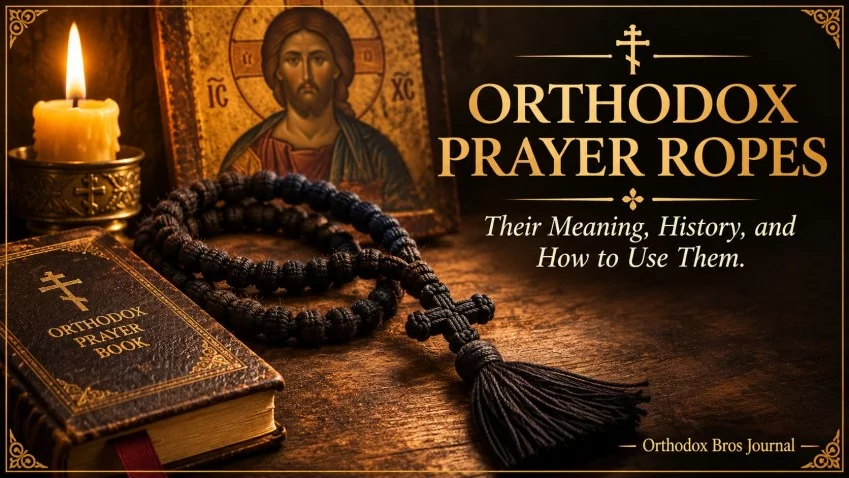
If you’ve spent any time around an Orthodox church, monastery, or gathering of Orthodox Christians, you’ve probably noticed them. Small loops of black wool wrapped around someone’s wrist. Longer cords of tightly woven knots hanging from a monk’s hand. Sometimes there is a little cross at the end, perhaps a tassel, or a few wooden beads separating groups of knots. To someone unfamiliar with Orthodox Christianity, they might look like simple bracelets or pieces of traditional religious jewelry.
But those little cords have a purpose that goes far beyond their appearance.
An Orthodox prayer rope is one of the simplest tools a Christian can use to help develop a consistent life of prayer. It doesn’t require batteries, an internet connection, or a complicated set of instructions. It doesn’t promise instant peace or extraordinary spiritual experiences. Its purpose is much more modest, and ultimately far more meaningful: to help us remember God, remain attentive in prayer, and return our thoughts to Jesus Christ when the distractions of everyday life begin pulling us elsewhere.
In an age when people spend enormous amounts of time tracking nearly everything, from their steps and sleep to their productivity and physical progress, the prayer rope offers a different kind of reminder. Its knots may help us count prayers, but the number itself isn’t the goal. What matters is whom we’re addressing, why we’re praying, and whether that prayer gradually shapes the way we live.
At Orthodox Bros, we’re interested in the ancient traditions of the Church and how they remain meaningful in ordinary modern life. The prayer rope is a wonderful example. Its history reaches back to the early Christian monastic tradition, yet its purpose remains just as relevant for someone living in a busy household, working a demanding job, or trying to establish a regular prayer routine today.
So what exactly is an Orthodox prayer rope? Where did it come from, what do its knots symbolize, and how should someone actually use one?
Let’s explore a tradition that is both remarkably simple and spiritually profound.
What Is an Orthodox Prayer Rope?
An Orthodox prayer rope is a cord or loop containing a series of knots or beads that a person moves through their fingers while praying. In Greek, it is commonly called a komboskini (also spelled komboschini), while in Russian and other Slavic contexts, the term chotki is widely used. You may also encounter the Serbian word brojanica, particularly when referring to smaller prayer ropes commonly worn around the wrist. Although their appearance and local customs vary, these objects share the same essential purpose: assisting the practice of prayer.
Traditionally, many prayer ropes are made from wool, often black, with knots woven in a distinctive pattern. Some are quite small, containing only 33 knots, while others have 50, 100, 300, or more. Larger prayer ropes are especially associated with monastic life, where they may be used as part of an established daily prayer rule. Smaller ones are convenient for laypeople who want to carry a prayer rope in a pocket or keep one nearby throughout the day.
The prayer most closely associated with the rope is the Jesus Prayer:
Lord Jesus Christ, Son of God, have mercy on me, a sinner.
With each knot, the person quietly repeats the prayer, allowing the physical movement of the fingers to provide a gentle reminder to remain attentive. The prayer may be said aloud, whispered, or offered silently, depending on the circumstances and the person’s prayer practice.
It is important to understand that the rope itself is not the source of spiritual power. It is an aid, much as a prayer book helps us remember the words of traditional prayers or an icon directs our attention toward the person depicted. A prayer rope can assist someone who is trying to pray, but it cannot replace sincerity, repentance, participation in the life of the Church, or the grace of God.
That distinction is essential. The Orthodox Christian does not place trust in the knots or the wool. Our trust is in Christ.
The History of Orthodox Prayer Ropes
The history of the Orthodox prayer rope is closely connected to the rise of Christian monasticism in the deserts of Egypt during the early centuries of the Church. Men and women withdrew from ordinary society to devote themselves more completely to prayer, fasting, repentance, and the struggle against sinful habits. Many lived under demanding conditions, balancing periods of prayer with manual labor and the necessities of daily survival.
These early monastics sought ways to pray regularly and attentively. Some followed fixed prayer rules that involved repeating short prayers or performing a certain number of bows and prostrations. Keeping track of those prayers could be difficult, particularly for monks who could not read or who were occupied with practical work. Traditional accounts describe the use of small stones, seeds, and eventually knotted cords as ways of marking the progress of a prayer rule.
The invention of the prayer rope is frequently attributed to Saint Pachomius the Great, a fourth-century Egyptian monk who played a major role in the development of communal monasticism. Another traditional account associates its early development with Saint Anthony the Great, whose life became an enduring example of ascetic struggle and devotion. These attributions belong to the Church’s received monastic tradition; the exact historical circumstances of the prayer rope’s invention cannot be established with certainty.
One familiar story tells of a monk who tried to keep track of his prayers by tying ordinary knots in a length of rope. According to the account, the devil repeatedly untied the knots in an attempt to disrupt his prayers. An angel then taught the monk to tie a more intricate knot incorporating the form of the Cross, which the devil could not undo.
The details vary between tellings, and this should be understood as a traditional spiritual story rather than a verified account of how a particular knot was invented. Its lesson, however, is unmistakable: the Christian life involves perseverance, and the Cross of Christ—not a piece of cord—is our hope in the struggle against temptation.
Over the centuries, the prayer rope became a familiar feature of Orthodox monastic life throughout the Christian East. Its use spread through Greek-speaking, Slavic, Romanian, Serbian, and other Orthodox communities, acquiring different names and variations along the way. It also became increasingly common among laypeople who wanted a simple way to practice the Jesus Prayer during daily life.
Today, prayer ropes can be found in monasteries and parish churches around the world. The materials may be different from those used centuries ago, but the underlying purpose remains the same.
What Do the Knots, Cross, and Tassel Mean?

The traditional Orthodox prayer rope has several features that carry symbolic meaning, although not every rope includes all of them.
The knots are the defining characteristic. Many traditional wool prayer ropes are made using a complex method of tying interwoven loops associated with the shape of the Cross. The result is a firm, textured knot that is easy to recognize by touch. This matters because prayer ropes are meant to be used without constantly looking at them. The fingers move naturally from one knot to the next while the person’s attention remains on prayer.
The black wool is traditionally associated with sobriety, mourning for sin, and repentance. Wool may also call to mind the sheep of Christ’s flock and the image of Jesus Christ as the Good Shepherd. These associations are part of the rich symbolic language of Orthodox Christian life, but they do not mean that every prayer rope must be black or made from wool. Other colors and materials are used, particularly in different cultural traditions.
The cross commonly found at the end of a prayer rope reminds us of Christ’s crucifixion, His victory over death, and the self-giving love at the center of Christianity. It also emphasizes that the prayer rope is not simply a counting device. Every prayer is offered in the context of our faith in the crucified and risen Lord.
The tassel, when present, is traditionally associated with tears of repentance. It serves as a reminder of the sorrow we feel when recognizing our sins, and the hope that comes from seeking God’s forgiveness. Not all prayer ropes include tassels, and their absence does not make a rope less appropriate for prayer.
Many prayer ropes also contain larger knots or beads at certain intervals. These help the person recognize progress through the rope without looking down or interrupting prayer. Depending on the design, they may separate groups of ten, twenty-five, or fifty knots.
None of these features should distract us from the rope’s basic purpose. Its beauty and symbolism can be appreciated, but the real value of a prayer rope becomes apparent through its use.
A beautifully handcrafted prayer rope that remains forgotten in a drawer offers little practical benefit. A simple, inexpensive rope regularly used in humble prayer may become a deeply meaningful companion in someone’s spiritual life.
Why Are Prayer Ropes Associated With the Jesus Prayer?
To understand the prayer rope, we need to understand the prayer most often offered with it.
The Jesus Prayer is among the best-known devotional practices in Orthodox Christianity. Its familiar form is straightforward:
Lord Jesus Christ, Son of God, have mercy on me, a sinner.
The words express several foundational truths of the Christian faith. By addressing Jesus as Lord and Son of God, we confess who He is. By asking for mercy, we acknowledge our dependence upon Him. By calling ourselves sinners, we recognize our need for repentance rather than approaching God with self-satisfaction.
Its simplicity should not be mistaken for a lack of depth. The prayer reflects themes found throughout Scripture, including the cries for mercy addressed to Christ in the Gospels and the prayer of the publican in Luke 18:13. It also relates to Saint Paul’s instruction to pray without ceasing in 1 Thessalonians 5:17. For centuries, Orthodox Christians have understood these teachings as encouragement to cultivate an ongoing awareness of God’s presence.
The Jesus Prayer is not an incantation. Its effectiveness does not depend upon saying the words a certain number of times or pronouncing them according to a secret formula. Nor should it be approached as a method of forcing a particular emotional or psychological experience. We are addressing a Person, not activating a technique.
Some Orthodox spiritual writings discuss advanced forms of contemplative prayer, sometimes associated with hesychasm, or the tradition of inner stillness. Such writings can be beautiful and challenging, but beginners should not attempt complicated breathing methods, physical techniques, or intense contemplative practices without appropriate spiritual guidance. The ordinary, attentive offering of the Jesus Prayer does not require any of these things.
For most of us, there is enough spiritual work in simply saying the words slowly, paying attention to their meaning, and remembering that we stand before God in need of mercy.
The prayer rope helps make room for that simple act.
How to Use an Orthodox Prayer Rope: A Beginner’s Guide
If you’ve recently purchased or received your first prayer rope, you may wonder whether there is a particular way you’re supposed to hold it, how many prayers you should say, or whether you need to perform additional actions with each knot.
Different Orthodox communities and spiritual fathers may provide somewhat different instructions, particularly concerning formal prayer rules. The following is a simple introduction to using a prayer rope, not a replacement for guidance from your parish priest.
1. Find a quiet place to begin.
Set aside a few minutes when you can pray without unnecessary interruption. You might stand or sit before your icon corner, or simply choose a quiet place in your home. If you are already following morning and evening prayers from an Orthodox prayer book, the Jesus Prayer can be incorporated into that routine in a manner appropriate to your prayer rule.
2. Hold the prayer rope comfortably.
Place the rope in either hand and hold a knot gently between your thumb and finger. There is no need to grip it tightly or create physical discomfort. As you pray, you can move to the next knot with your thumb. The movement should be natural and unobtrusive, helping you remain attentive rather than becoming a distraction of its own.
3. Say the Jesus Prayer slowly and attentively.
Offer the prayer without rushing:
Lord Jesus Christ, Son of God, have mercy on me, a sinner.
When you finish, move your fingers to the next knot and repeat the prayer. If you lose your place or become distracted, simply return your attention to the words. You do not need to become irritated with yourself or restart the entire rope every time your thoughts wander.
4. Keep the practice manageable.
Someone beginning to use a prayer rope does not need to complete hundreds of repetitions. A modest period of attentive prayer is a sensible starting point. If you want to establish a particular number of prayers as part of a regular spiritual discipline, discuss that rule with your priest or spiritual father rather than imposing an ambitious schedule on yourself.
5. Remember that the number is not the goal.
The knots help keep track of prayers, but they are not a spiritual scoreboard. Finishing a hundred prayers while rushing through the words is not necessarily more fruitful than offering a smaller number with attention and humility. The purpose is to turn toward Christ and ask for His mercy, not to demonstrate endurance.
6. Return to ordinary life with the prayer in mind.
When your period of prayer is finished, continue with your responsibilities. You might repeat the Jesus Prayer quietly while walking, waiting, or completing a familiar task that does not require your full concentration. Do so with common sense and attention to your surroundings; prayer should never become a reason to neglect safety, work, or the people who need you.
As prayer becomes more familiar, you may find that the rope is no longer necessary every time you offer the Jesus Prayer. That is perfectly natural. The rope is a helpful aid, not a required condition for prayer.
Building a Regular Prayer Habit in Everyday Life
One of the great challenges of modern life is finding quiet time amid constant distractions. Many of us begin the morning already thinking about work, appointments, household responsibilities, or the messages waiting on our phones. By the evening, we’re often tired and tempted to put off anything that requires sustained attention.
A prayer rope can help us establish small moments of prayer in the midst of that busyness. Someone might keep one near an icon corner and use it after morning prayers. Another person might carry a small rope in a pocket as a reminder to pray during a break. A parent may find that a few quiet minutes after the household settles are more realistic than an elaborate routine that never quite fits the day’s demands.
There is value in learning to work with the responsibilities we actually have. An Orthodox Christian raising young children, caring for an elderly parent, or working long shifts will not necessarily have the same opportunities for prayer as someone living in a monastery. The goal is not to imitate another person’s schedule regardless of circumstances. It is to make room for prayer with sincerity, faithfulness, and sound judgment.
It is also worth remembering that a prayer rope is meant to assist our relationship with God, not become another item on an already overwhelming list of obligations. If you find yourself becoming excessively anxious about completing a certain number of repetitions, or judging others according to how frequently they use a prayer rope, something important may have gone wrong.
Prayer should draw us toward humility, repentance, and love. The discipline of regularly showing up matters, but so does the spirit in which we approach it.
As with so many worthwhile practices, consistency is often more useful than intensity. A simple prayer habit maintained over time can gradually become part of the ordinary rhythm of life.
Why Do Orthodox Prayer Ropes Have 33, 50, or 100 Knots?
Prayer ropes are available in many sizes, and the different numbers naturally lead to questions about their meaning.
A 33-knot prayer rope is particularly common among laypeople because it is compact and easy to carry. The number is traditionally associated with the years of Christ’s earthly life. These shorter ropes are often worn around the wrist, although they may just as easily be kept in a pocket or placed near a person’s prayer books and icons.
A 50-knot prayer rope provides a somewhat longer sequence of prayers while remaining manageable for everyday use. It can be a practical option for someone who wants something larger than a small wrist rope but does not need an especially long one.
A 100-knot prayer rope is a familiar traditional form, especially in monastic settings, though it is by no means reserved for monks. Some longer ropes contain 150, 300, or more knots and may be associated with particular prayer rules or monastic customs.
The different sizes should not be understood as spiritual ranks or measures of dedication. Owning a longer prayer rope does not make someone more faithful, just as using a shorter rope does not indicate that a person takes prayer less seriously.
What matters is choosing a rope that is practical for its intended use and approaching prayer with the right attitude.
Can You Wear an Orthodox Prayer Rope on Your Wrist?
Yes. Small prayer ropes are commonly worn around the wrist in various Orthodox communities, particularly in Greek and Serbian traditions. When worn appropriately, a prayer rope can serve as a discreet reminder to turn one’s thoughts toward God throughout the day.
But there is an important distinction between wearing a prayer rope as an aid to prayer and treating it primarily as a fashion accessory. Although some prayer ropes are beautifully made, their religious meaning should not be forgotten. They are not supposed to function as lucky charms, magical protection, or displays of personal spiritual achievement.
Orthodox Christians also differ in how they approach wearing and carrying religious objects. Some prefer to keep a prayer rope discreetly in a pocket, while others wear one openly on the wrist. In monasteries, particular customs may apply, and individual priests may offer guidance depending on the circumstances.
There is no reason to turn those variations into arguments about who is practicing Orthodoxy correctly. A person can wear a prayer rope conspicuously and rarely pray, while another can carry a simple rope privately and use it faithfully. The reverse may also be true. We cannot judge the spiritual condition of someone else by looking at their wrist.
The best question is not whether wearing a prayer rope makes us appear more Orthodox. It is whether the rope is helping us remember Christ and live more faithfully.
Is an Orthodox Prayer Rope the Same as a Catholic Rosary?
Orthodox prayer ropes and Roman Catholic rosaries share a visible similarity: both can use knots or beads to help organize repeated prayers. However, they developed within different devotional traditions and are generally used in different ways.
The traditional Orthodox prayer rope is most closely associated with the Jesus Prayer, while the Roman Catholic Rosary has its own established pattern of prayers and meditations. The two practices should not simply be treated as interchangeable because their counting devices resemble one another.
At the same time, it is unnecessary to turn the comparison into an argument or a competition. Someone unfamiliar with Orthodoxy may naturally refer to a prayer rope as a rosary because it is the closest object they recognize. That provides a useful opportunity to explain the Orthodox tradition respectfully.
The important point is that an Orthodox prayer rope belongs to a wider life of prayer, worship, repentance, and participation in the Church. Understanding that context is far more useful than becoming preoccupied with differences in appearance alone.
Common Misunderstandings About Orthodox Prayer Ropes
One misconception is that the prayer rope itself possesses supernatural power. Orthodox Christians may treat prayer ropes with reverence, and some receive them as blessings from a monastery or priest, but the rope is not a magical object. Its purpose is to assist prayer, not to guarantee protection or obtain particular outcomes through physical possession.
Another misunderstanding involves the number of prayers offered. It can be tempting to approach the rope as a way of measuring spiritual productivity, particularly when we’re accustomed to tracking progress in other areas of life. Yet prayer cannot be reduced to a number. A person may complete an extensive rule and still struggle with anger, dishonesty, or indifference toward others. The words of prayer should lead us toward repentance and a more faithful life.
A third misconception is that prayer ropes are intended only for monks and nuns. The tradition developed within monasticism, and the rope carries particular significance in monastic life, but laypeople have used prayer ropes for generations. A Christian does not need to live in a monastery to benefit from the Jesus Prayer. What matters is approaching the practice with humility and avoiding spiritual disciplines that are inappropriate for one’s circumstances.
Finally, some assume that using a prayer rope will automatically produce a peaceful emotional state. Prayer can certainly bring comfort, but that is not a result we can demand. There will be days when we feel distracted, tired, frustrated, or spiritually dry. The purpose is not to manufacture a particular sensation. It is to turn toward God faithfully, whatever our passing emotions may be.
These misunderstandings share a common problem: they place too much emphasis on the object, the technique, or the individual experience, and too little on Christ.
Choosing Your First Orthodox Prayer Rope
If you’re considering obtaining your first prayer rope, there is no need to make the decision complicated. A traditional 33-knot wool rope is a practical choice for many beginners, especially if you would like something small enough to carry throughout the day. A 50- or 100-knot rope may be preferable if you intend to keep it in your prayer corner or incorporate it into an established prayer rule.
Look for something that is comfortable to hold, reasonably durable, and appropriate for prayer. The knots should be easy to distinguish by touch, and the rope should not be so fragile that ordinary handling causes it to unravel. Handmade prayer ropes from Orthodox monasteries and reputable church suppliers can be meaningful choices, particularly when their purchase also supports a monastic community.
You may also wish to ask your parish priest about local customs and whether he recommends having the prayer rope blessed. Practices vary, and there is value in learning from the people responsible for guiding the spiritual life of your parish.
Avoid assuming that expensive materials, elaborate ornamentation, or an unusually large number of knots will provide a better spiritual experience. A simple prayer rope used attentively serves its purpose perfectly well.
Above all, remember that obtaining a prayer rope is not the same thing as developing a life of prayer. That begins when we actually turn our hearts toward God.
Prayer, Humility, and the Life of the Orthodox Church
There is a reason the Orthodox tradition places such importance on the inner life. We can become extraordinarily skilled at maintaining an outward appearance while neglecting the condition of our hearts. It is possible to know religious terminology, admire beautiful icons, attend church regularly, and still struggle with impatience, resentment, or a lack of compassion. None of us is beyond the need for repentance.
The Jesus Prayer reminds us of that need in remarkably direct language. We call upon Christ by name and ask for mercy. We acknowledge that our salvation does not come from impressing other people or accumulating religious accomplishments. Our hope rests in the mercy and grace of God.
This understanding also helps explain why the prayer rope should never be separated from the broader life of Orthodox Christianity. Private prayer is important, but it does not replace the Divine Liturgy, the sacraments, the guidance of the Church, or the responsibility to love and serve others. The spiritual life is not an individual experiment conducted in isolation from the Christian community.
At Orthodox Bros, we often speak about faith, discipline, and strength. A prayer rope offers a valuable reminder that spiritual discipline is fundamentally different from physical training. We may strengthen our muscles through repeated exercise, but holiness is not something we manufacture through greater effort alone. Prayer calls us to cooperate with God’s grace, recognize our limitations, and become more attentive to His will.
The deeper our understanding of that distinction, the less likely we are to confuse outward discipline with genuine spiritual growth.
Frequently Asked Questions About Orthodox Prayer Ropes
Do you have to be Orthodox to use a prayer rope?
The Jesus Prayer can be offered by anyone sincerely seeking Christ. However, the prayer rope belongs to a particular Christian spiritual tradition, and those interested in using one would benefit from understanding that tradition rather than treating it as an isolated technique. If you’re exploring Orthodox Christianity, speaking with a parish priest is an excellent place to begin.
Does a prayer rope have to be blessed?
Practices differ between parishes and local Orthodox traditions. Some people obtain prayer ropes that have been blessed at monasteries or ask their priest to bless one they have purchased. If you’re uncertain, simply ask your priest about the customary practice in your parish.
Can you pray without a prayer rope?
Absolutely. The prayer rope is an aid to prayer, not a requirement. The Jesus Prayer can be offered quietly while walking, working, resting, or going about ordinary responsibilities. You do not need to hold an object in order to turn your thoughts toward God.
How many times should you say the Jesus Prayer?
There is no universal number appropriate for everyone. A particular count may be included in a prayer rule given by a priest or spiritual father, but the goal is not to achieve the highest possible total. Beginners should emphasize attention, humility, and consistency rather than attempting large numbers of repetitions without guidance.
What should you do if your mind wanders during prayer?
Return your attention to the words without becoming frustrated. Distraction is a common difficulty in prayer, and the prayer rope can help by providing a gentle physical reminder of where you are. The purpose is to keep returning to Christ, not to prove that you can maintain perfect concentration.
Are prayer ropes only for men?
No. Orthodox prayer ropes are used by men and women, monastics and laypeople, across different ages and cultural traditions. Their purpose is prayer, and that purpose is not restricted by gender.
A Small Rope, a Meaningful Reminder
There is something refreshing about an object that asks so little of us in material terms. A prayer rope doesn’t have to be expensive or elaborate. It doesn’t require us to master complicated instructions before we can begin. It simply offers a quiet reminder that prayer deserves a place in everyday life.
Yet the simplicity of the prayer rope should not cause us to underestimate the tradition behind it. Generations of Orthodox Christians have used these humble cords to help remain attentive to God through lives filled with difficulties, responsibilities, joys, and disappointments. Monks have held them during long hours of prayer. Ordinary Christians have carried them through the demanding routines of family life, labor, illness, and old age.
The circumstances may change, but the need for God’s mercy does not.
We live in a world that rewards attention, appearance, achievement, and constant activity. The prayer rope reminds us of something quieter. We need to pray. We need to repent. We need to remember that our worth is not measured by the admiration of others or the accomplishments we can display.
Sometimes the most meaningful thing we can do is set everything else aside for a moment, hold a simple knot between our fingers, and say:
Lord Jesus Christ, Son of God, have mercy on me, a sinner.
One prayer at a time.
Ancient Faith. Modern Brotherhood.
Continue Exploring Orthodox Bros
Interested in the meaning behind other Orthodox Christian traditions and symbols? Explore the Orthodox Bros Journal for more articles about ancient faith, spiritual discipline, and everyday Christian life.
You can also read about our Faith, Fitness & Brotherhood philosophy and how we approach healthy living with humility and purpose.